
World Drowning Prevention Day: Atlantic Pacific Appeals for Water Safety
World Drowning Prevention Day is a United Nations-recognised global advocacy event, held annually on 25th July, “to highlight the tragic and profound impact of drowning on families and communities and to offer life-saving solutions to prevent it.”
Stakeholders, such as governments, UN agencies, community and non-profit organisations, the private sector, academia and individuals, are invited to mark the day, thereby raising awareness of the need for urgent, coordinated action on drowning. So, what can we do?
The scale of the problem
Each year, an estimated 236,000 people die from drowning, according to the World Health Organization (WHO), and it is one of the leading causes of death for children and young people aged 1–24. Yet, unlike other major public health threats, drowning remains critically under-resourced and poorly understood.
In Japan, the number of drownings hit a 10-year high in 2024, with 1,535 recorded, up by more than 140 year-on-year, according to the National Police Agency. Of the cases last year, 372 occurred in the sea, followed by 288 in rivers, 100 in irrigation waterways, 39 in ponds or lakes and three in swimming pools. Some also occurred in onsen hot springs.
This summer, the agency is therefore reminding people to supervise children near bodies of water and to avoid deep water, fast currents and slippery spots.
Ahead of World Drowning Prevention Day, the Japan Lifesaving Association is also calling on water users to “learn the ability to understand and survive the dangers around water” under this year’s slogan, Swim & Survive.
Raising awareness: education and campaigns
Atlantic Pacific is a humanitarian organisation whose mission is to combat global drowning by providing innovative, sustainable and community-led solutions. Based at UWC Atlantic, Wales, the non-profit provides education on water safety and rescue techniques, as well as lifeboats and training to communities lacking water rescue services.
From its Welsh coastal workshop and classrooms, Atlantic Pacific has launched an international response to drowning, deploying teams and trained communities in Italy, Greece and Japan through its community-run rescue unit, Lifeboat in a Box, that empowers local people to respond to water-related disasters before outside help arrives.
In Kamaishi, Iwate Prefecture, which was devastated by the 2011 tsunami, the team works with local schools and coastal authorities to educate young people in water safety and basic rescue, transferring skills and saving lives while supporting coastal resilience planning.
This year, Atlantic Pacific is continuing its work to combat drowning with efforts tied to World Drowning Prevention Day.

Sea safety and cold water shock
According to Kate Sedwell, co-founder and chief operating officer of Atlantic Pacific, education is one of the most effective tools to reduce death by drowning.
The organisation has colourful resources, in both English and Japanese, geared to young children, including their illustrated “4 Rules of Sea Safety”:
Stop and think
Stay together
Float
Call for help
Other materials explain cold water shock, a dangerous physiological reaction that occurs when a person is suddenly immersed in cold water, typically below 15˚C. It can cause uncontrollable gasping, rapid breathing, increased heart rate, panic, reduced strength and coordination and hypothermia; all of these are factors that can lead to drowning, even for strong swimmers.
As average sea temperatures globally vary between 12–17˚C, and fresh water rivers are even colder, it is possible to experience cold water shock in Japan, depending on the time of year and the region.
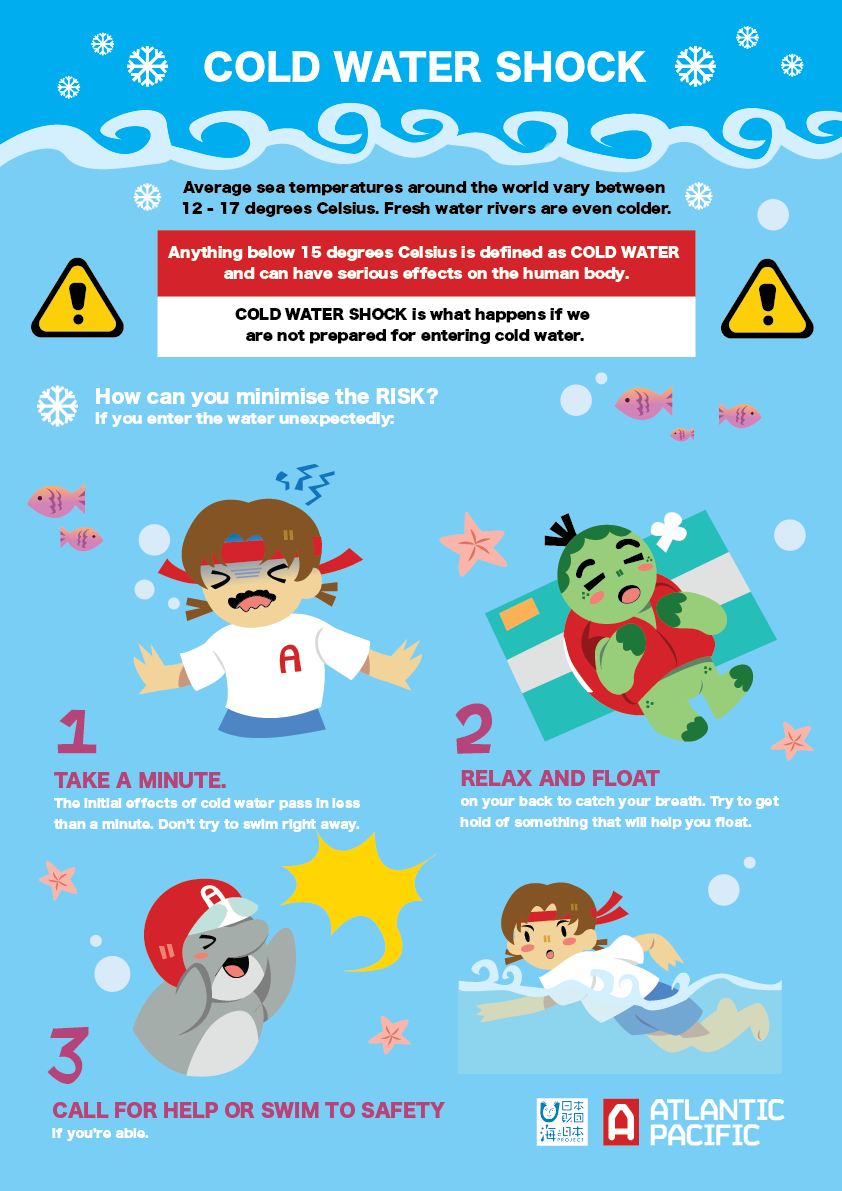
Atlantic Pacific’s advice for anyone who finds themselves unexpectedly in cold water is the following:
Take a moment; the initial effects of cold water pass in a few minutes. Don’t try to swim right away.
Relax and float on your back to catch your breath. Try to get hold of something that will help you float.
Call for help or swim to safety if you’re able.
With summer holidays underway in Japan, Sedwell recommends parents and care givers talk to children and young people about the risks posed by playing in or near bodies of water and how they can stay safe.
“Children and young people, particularly boys, tend to have a higher risk appetite for activities like jumping into rivers, so it’s important we explain water safety,” she said.
Meanwhile, to combat drowning in an onsen, which is typically caused by fainting while in or getting out of the water, it’s important to limit soaking time, hydrate well before bathing and take breaks out of the water when needed. These actions are especially important in summer, when risk of heat fatigue or heat stroke is already high due to the hot, humid weather.
Drowning first aid
CPR is performed differently on drowning victims; rescue breaths are required immediately to clear water from the lungs and deliver oxygen, whereas conventional CPR prioritises chest compressions. Atlantic Pacific can provide a drowning first aid course, which includes how to perform CPR on a drowning victim, to BCCJ members who are interested. Please inquire.
Additional resources
UWC Atlantic Marks World Drowning Prevention Day
More on World Drowning Prevention Day from the WHO
WHO guidance on helping plan activities to mark World Drowning Prevention Day
#WorldDrowningPreventionDay