Rolls-Royce & BAE Systems Science Camp 2025 Features Capacitor Plane Development for the First Time
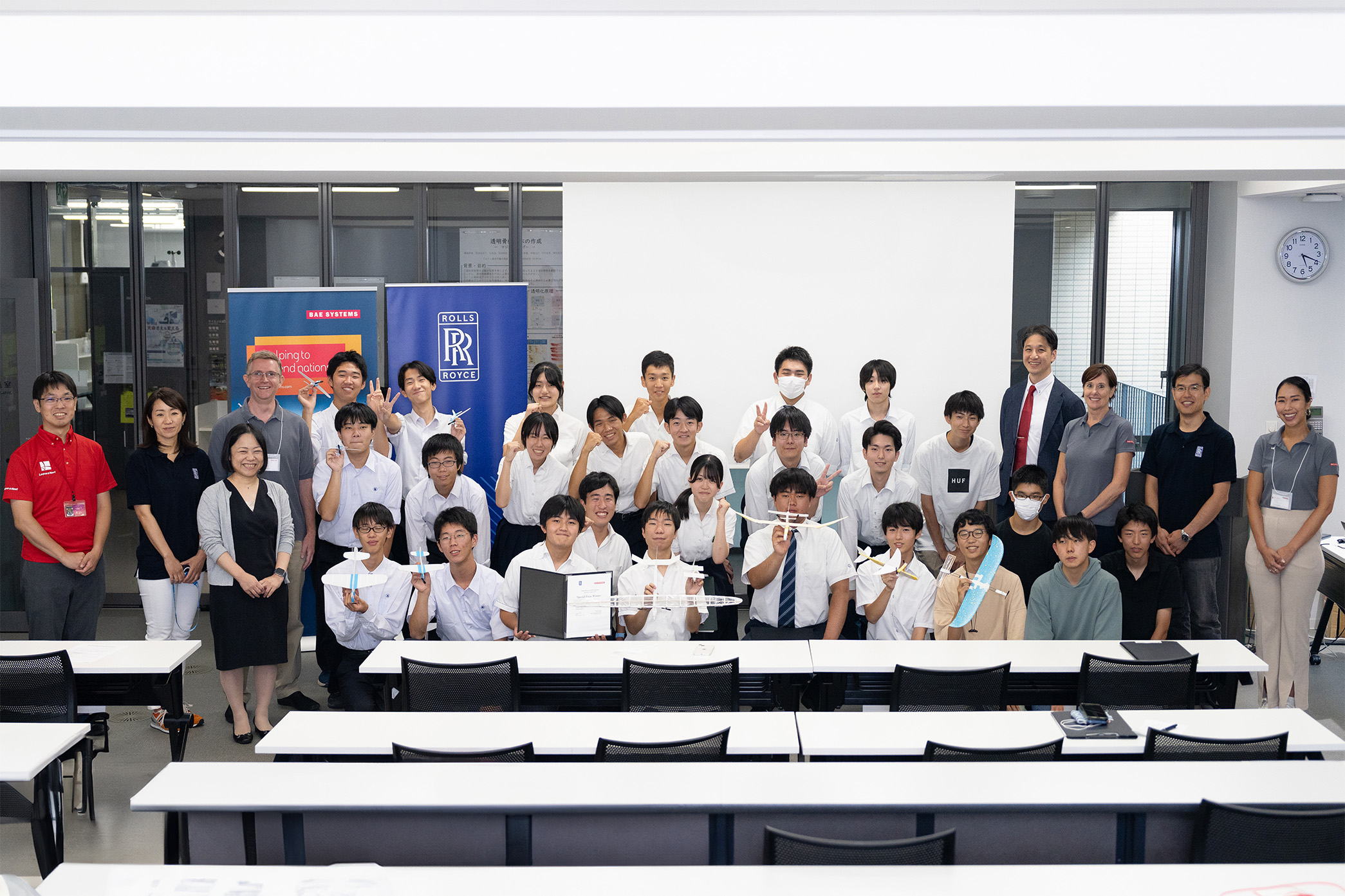
Global engineering companies BAE Systems and Rolls-Royce have held the Rolls-Royce & BAE Systems Science Camp 2025, a continuation of their joint STEM education programme in Japan from last year. 76 high school students from 12 schools were selected to spend a month developing their planes to take part in an online qualifying competition in June. The chosen finalists had two months to further improve their planes’ performance before taking part in the finals in Tokyo on 20th August .
You can view video highlights of the Rolls-Royce & BAE Systems Science Camp 2025 from this link, or via YouTube here.
This year's science camp curriculum featured a new component: the capacitor plane. The challenge for the students was to develop an airplane powered by electricity stored in a capacitor, with teams competing based on flight performance.
At the final, held at Dalton Tokyo Junior & Senior High School, the teams gave presentations on their plane development, followed by a competition on flight performance. The latter was judged according to two categories: speed, based on how quickly they could fly a 20-meter course, and weight, based on how much weight they could transport. From the scores in each category and an additional assessment that considered various aspects of development, a Grand Prize and Special Prizes were awarded.
A special lecture was also delivered by Ms. Rie Sota, an All Nippon Airways (ANA) engineer who was seconded to a Rolls-Royce facility in the UK under an engineer training program. She shared valuable insights for students interested in pursuing STEM fields, discussing her career path from her student days to her current technical role.
The following day, the four finalist teams visited the Acquisition, Technology & Logistics Agency’s Air Systems Research Center in Tachikawa, Tokyo. They learned about the research center's activities, observed a low-speed wind tunnel, heard about aerodynamic research, and viewed historical jet engines used in defence equipment, gaining insights into technological evolution.
Susumu Kaminaga, President and Representative Director, Rolls-Royce Japan, said:
'This year, we were very pleased to be able to hold the program jointly with BAE Systems again. We wanted to present the students with a new project, which proved to be suitably difficult, as even flying straight presented difficulties! Nevertheless, seeing the students brainstorm ideas together as a team and overcome challenges through trial and error, I felt as if I was in the presence of talented future engineers, who have the potential to lead the way to Japan's future.'
'Rolls-Royce believes in the importance of continuous development of STEM talent. In Japan, beyond this Science Camp, we also conduct STEM support activities including lectures and demonstrations at schools and exhibiting at youth science festivals. We hope these experiences help our youth discover what excites them and become a stepping stone for their success in this field.'
Rob Peer, President, BAE Systems Japan GK, said:
'BAE Systems is proud to support the Science Camp for the second year. Engineers are a critical part of everything we do and we are committed to developing their skill sets at all career and life stages. Our collaborative projects in countries like Japan offer long term creative and exciting engineering challenges to inspire the next generation of engineers. BAE Systems spent £5.4 million last year promoting the importance of STEM globally, and in the UK we run a schools roadshow programme which has met with 1.3 million young people since 2005.'
'BAE Systems will continue to support this Science Camp to develop Japan's next generation of engineers.'
BAE Systems and Rolls-Royce focus on STEM education to help foster the next generation of scientists and engineers globally. The Science Camp encourages high school students’ interest in STEM careers through hands on activities, allowing students to experience the fun of practical challenges as well as providing opportunities to interact with engineers. STEM talent is not only vital for the future of both businesses, but also for the growth of highly skilled jobs which are needed to boost economic progress and transformative technological advancements.
*Rolls-Royce & BAE Systems Science Camp 2025 is a science, technology, engineering and math (STEM) education program for high school students. Launched in 2017 by Rolls-Royce, since 2024 it has been run jointly with BAE Systems. The program was run by Leave a Nest Ltd. and was supported by Rolls-Royce and BAE Systems employees.