
Member Article: What Does an AI-Ready Child Actually Look Like?
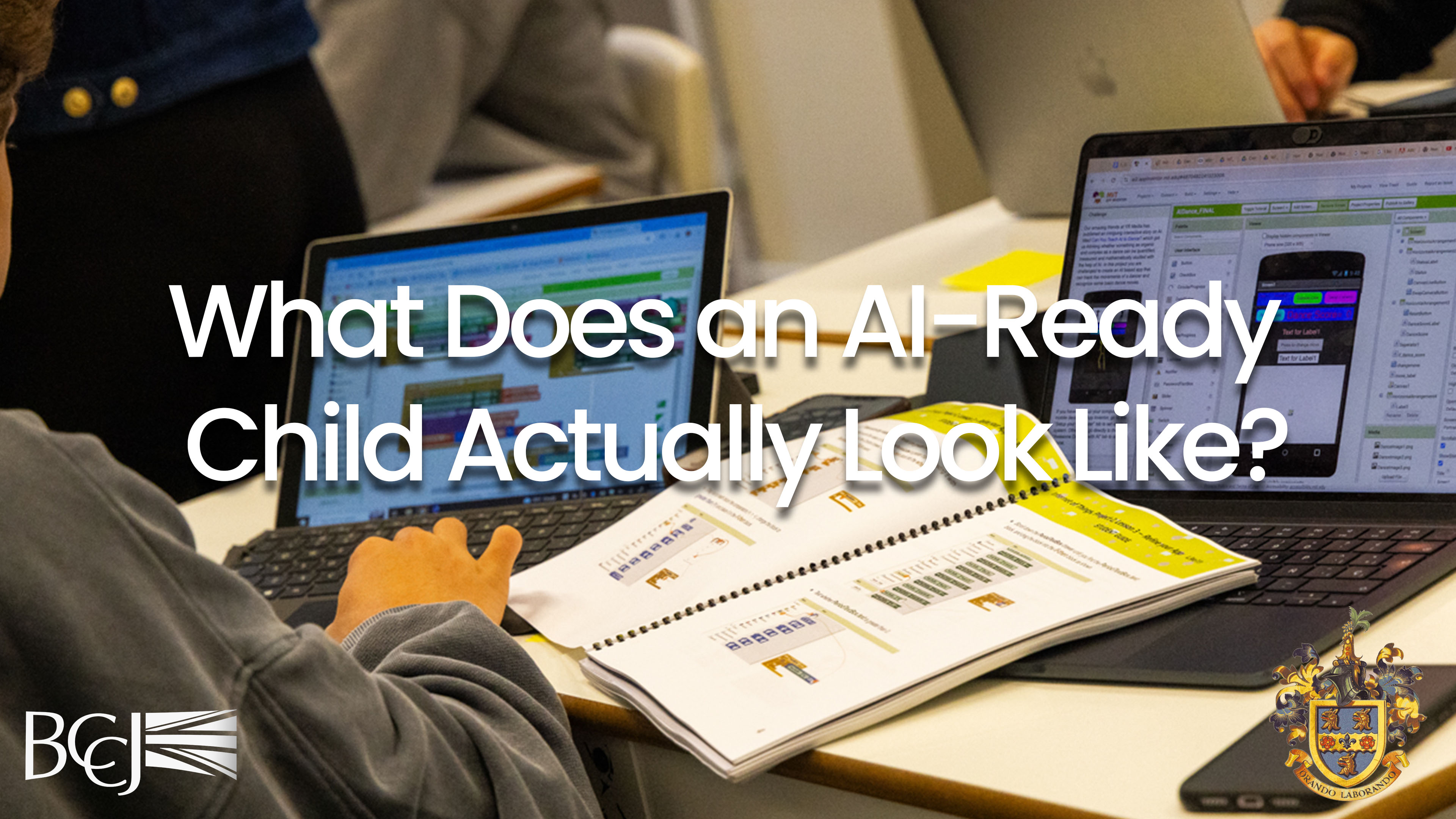
The British Chamber of Commerce in Japan is pleased to circulate this piece by Rugby School Japan.
Nobody really knows what jobs will exist in fifteen years. This is not pessimism, it is just the honest starting point for any serious conversation about education and artificial intelligence right now.
A group of educators from MIT RAISE and Rugby School Japan recently sat down to discuss this exact point, specifically for parents wondering what they are supposed to do about it. The consensus? The window to act is open, but it will not stay that way forever.
The entry-level job problem
One of the more uncomfortable threads running through the discussion was what is happening to entry-level work. Felipe Arango, who co-founded Pharos Education, spent time as an analyst at McKinsey and was candid about what that kind of early-career work actually involved.
‘I had to do a lot of research, a lot of analysis, a lot of PowerPoint for big corporations. That is probably now better done by AI.’
He is not wrong, and he is not alone in saying it. Across industries, the jobs that used to give young graduates their first foothold, the work of gathering, summarising, formatting, and presenting, are exactly the kind of tasks that AI handles quickly and without complaint.
For the next generation, this presents a real problem, not because companies are laying off junior staff out of cruelty. AI is simply disrupting the labour market, and it is for educators and families to navigate these changes. The more useful question, the panellists agreed, is this:
Which skills sit above this disruption line?
The honest answer to this question is that nobody yet has a definitive list. But ask anyone working seriously at the intersection of AI and education, and certain things surface consistently enough to be worth paying attention to.
Hanna Adeyema, who directs immersive programme innovation at MIT RAISE, drew a distinction that cuts through a lot of the noise.
‘The skills being eroded by AI,’ she said, ‘are the more mechanical ones - recalling facts, summarising information, pattern-matching across data. The skills becoming more valuable are harder to name cleanly. These include the ability to connect with other people, to manage yourself, and to care enough about something to actually pursue it.’
She used the word ‘agentic,’ then immediately pulled back from it. What she meant, she clarified, was simpler: initiative. Genuine interest. The desire to go and do something, rather than just respond to prompts.
Jeff Freilich, MIT RAISE Program Lead (AI Literacy), pushed this idea further. He explained that - in a world where AI can produce polished, competent prose on demand - the ability to express yourself with actual clarity and personality becomes - paradoxically - more valuable, not less.
‘Those that really know how to write, that are able to distil their own thoughts into very precise and salient ways of expression - this is a uniquely human skill.’
The students who develop a genuine voice and who can think on paper, are not being displaced by AI.
They are being distinguished by it.
What both were circling, without quite using the word, was character. Not in a vague, assemblies-and-mottos sense, but in the practical sense of someone who knows what they think, can articulate it, and has the self-direction to act on it.
Character has always mattered. What has changed is that it is now one of the only things AI cannot replicate.
What universities are actually looking for now
Yesenia Castelan, who guides students through the university admissions process at Rugby School Japan, has watched this shift play out in applications over the past few years.
‘The students who are getting into strong universities tend to share something beyond good grades. They are genuinely curious. They have followed interests that led somewhere, even if they could not have told you where at the start. They know themselves well enough to write about it without sounding like they are reading from a template’
That last point matters more than it might seem. With AI making it easy to produce a polished personal statement, universities have become adept at spotting when the voice in an essay does not quite belong to the person applying.
‘Brown University,’ Yesenia noted,’ now invites applicants to submit unedited video responses.’
No production value, no script. Just the student, on camera, talking about what they care about. That is not an accident; it is a direct response to the AI essay problem.
Interviews are becoming more important for the same reason. So is the overall portfolio of what a student has actually done: competitions entered, projects built, interests pursued beyond the syllabus.
‘It is one thing to have an interest,’ Yesenia said, ‘but you need evidence to show it.’
Felipe, who went through the Harvard admissions process himself, was direct about what distinguishes successful applicants at top universities.
‘You need a spike. What makes you different? What can you contribute?’
His argument was that AI, used well, actually helps students develop those spikes faster than any previous generation could. If you are curious about a topic and willing to go deep, AI can tutor you, help you build things, and point you toward ideas you would never have found otherwise.
‘The students using it that way,’ he said, ‘are getting ahead. The ones using it to generate homework are not.'
What can parents do in practice?
The practical advice from the panel of educators and AI experts was reassuringly simple: Hanna’s suggestion was essentially to get out of the way of your child’s curiosity and protect the space they need to follow what actually interests them.
‘Give your children a chance to preserve and grow their curiosity for the things they really care about.’
In a world where AI can produce competent work on almost any topic, what differentiates a person is whether they actually care, and caring is something you cannot outsource or speed-run.
Jeff’s suggestion added an extra layer of practicality. Rather than trying to stay one step ahead of your children technologically, let them lead.
‘Children today know their mobile phone better than you do,’ he said, speaking, he admitted, for himself as much as anyone.
If you want your child to develop genuine confidence and ownership over what they are learning, asking them to explain it to you is one of the most effective things you can do. It also, not incidentally, forces them to actually understand it rather than just consume it.
Yesenia drew an analogy many of us can easily relate to: the panic over calculators. There was a time when letting children use calculators in maths class felt like cheating, like it would weaken mental ability. It did not. Later, the same argument applied to spellcheck. The same argument now applies to AI.
‘Trying to resist it for so long is not always the best approach.’
Felipe pushed even further on one specific point: Do not let your child stop at the chat interface. Using ChatGPT to get answers to questions is fine, but it is the shallow end. The students who are genuinely building something - an app, a website, a project that solves a real problem - are developing a completely different relationship with the technology. One where they are in charge of it, rather than dependent on it.
An easy way to start
If you are looking for somewhere to start, Rugby School Japan is running a hands-on summer programme this June in partnership with MIT RAISE - the same experts behind this conversation.
The MIT RAISE FutureBuilders Programme is built for students who are ready to move beyond using technology to shaping it. Through practical, project-based learning, participants develop the mindset and skills of builders, thinkers, and problem-solvers - not passive consumers.
The differentiator, when every student has access to the same AI tools, is knowing what to do with them. That begins with an education that treats AI as a collaborator rather than a shortcut.
The programme runs 28 June to 3 July on Rugby School Japan’s campus, around thirty minutes from Tokyo, with residential and day options available. Given the people driving this conversation, it is well worth a look.
Find out more about the MIT RAISE FutureBuilders Programme at Rugby School Japan by clicking here.