Human vs. Machine: The Great Business Reshape
Artificial intelligence (AI) is reshaping the world of work, driving change in everything from task management and workflows to data analysis and job roles while posing significant ethical and governance challenges for organisations.
In HR, this new and rapidly evolving technology is redefining how organisations attract, manage and retain talent, as well as how they streamline recruitment, improve decision-making and implement AI-driven solutions ethically and responsibility for the betterment of their people and culture.
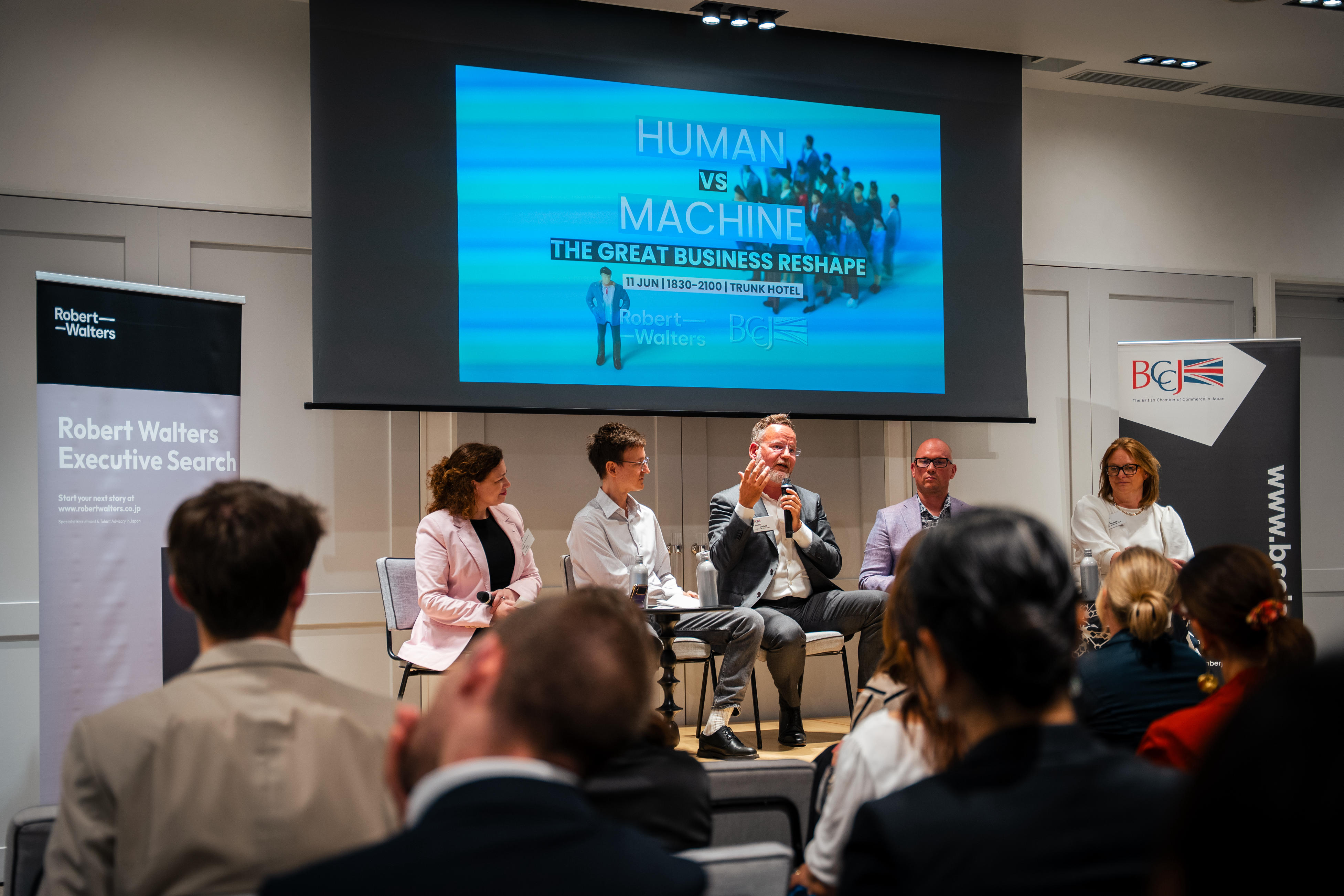
With AI presenting as one of today’s most pressing business challenges, the British Chamber of Commerce in Japan (BCCJ) held an event sponsored by global talent solutions business Robert Walters Japan to consider how AI can be utilised to transform recruitment, HR operations and compliance.
The speakers comprised Faye Walshe, Director of Innovation & AI at Robert Walters; Christopher Snow, Partner, Interim Professionals Practice Leader at EY Strategy & Consulting; Harold Godsoe, AI Risk Counsel at Kojima Law Offices; and Ilya Kulyatin, Founder of Tokyo AI Hub; with moderation by BCCJ Executive Committee Member Nicola Vote.
Boosting productivity, efficiency
Walshe began by outlining how AI is being used in the talent acquisition space, including the recruitment process, for both candidates and employers. One example is ChatGPT, a conversational AI chatbot that gained one million users within five days of its launch in November 2022, according to its developer OpenAI.
Approximately 70% of recruiters at Robert Walters use the company’s private version of ChatGPT comfortably every day, she said. The technology is capable of providing “hyper-relevant” interview questions for a role and a competency-based metric to evaluate responses alongside examples of perfect answers, allowing one recruiter to brief multiple hiring managers without the need for years of training. It can also be used to generate job advertisements and update a library of policies and job descriptions, including using prompts such as “mimic our corporate tone.”
“AI is an acceleration to productivity,” she said. “It can be your AI brainstorming buddy.”
ChatGPT can also be used to find and engage with new candidates, which is especially useful for recruiters working in niche areas. Walshe shared that outreach emails written using AI have a 40% higher response rate because of the increased quality of writing and targeting. Moreover, hiring managers who have many unsuccessful applicants but not enough time to contact them all can provide simply “one bullet point of feedback” on a candidate to ChatGPT, which can generate emails that garner a “great branding experience of the company.”
Since late 2024, Robert Walters has been trialling Microsoft Co-pilot, an AI companion that supports users with such tasks as making PowerPoint presentations, analysing data in Excel and summarising meetings in Teams.
Both it and ChatGPT, according to Walshe, require users to prompt or ask specifically what they need, so organisations should “think about how people need to be trained.” At Robert Walters, staff have been given access to a “prompt library” and the business has designed one-click AI solutions, such as their Ai AD Writer, which has accelerated their use of AI to boost productivity and efficiency.
LinkedIn now offers AI support at the click of a button, too, following its promise to start refining the hiring journey for employers and candidates at the end of 2023, she said. The technology can write a job advertisement using just a job title, send emails to candidates and search for candidates on the platform who match the role.
Other AI tools on the market consider the inclusivity of text to help ensure job descriptions are attracting the broadest audience.

AI for candidates
With AI transforming the recruitment lifecycle, candidates are using it to improve their chance of success in the hiring marketplace. For example, candidates can ask LinkedIn’s AI tools to write their profile or use platforms such as LazyApply to apply for thousands of jobs in a single click. Robert Walters is therefore receiving both a greater volume and better quality of applications as more candidates turn to AI, Walshe explained.
“We are finding it hard to determine the skills of people who are applying if we haven’t met them in person,” she said, noting that there have even been cases globally of video interviews where applicants were found to have used AI to answer questions or mask their face to conceal their identity. For Robert Walters, then, although AI is being used to cut through the volume of applications, at the final stages of the process, “making human connections is the difference now.”
Humans with machines
Although AI will result in the loss of some jobs, “humans will still have an advantage” because they have an understanding of the world that technology cannot obtain with the current state of AI, said Kulyatin of Tokyo AI Hub.
In addition to presenting opportunities for people to extend their capabilities, AI could act as a support tool to help break academic silos and allow for more cross-disciplinary work to happen, he said.
In Japan, for example, there are 700,000 fewer software engineers in the market than are required and there is only one person for every two AI engineer positions. However, AI will increase the capability of people, meaning fewer are needed in these roles, putting Japan at an advantage if compared to the US, where hundreds of thousands of software engineers are being displaced, he added.
For EY, considering how AI will reimagine the workplace means “understanding what we’re doing, rule by rule,” said Snow. In his team, efforts are focused on embedding AI capability to make staff functional now and in the future as the world becomes increasingly complex, he added, pointing out the need “to empower teams to learn” about this new technology.
Godsoe of Kojima Law Offices agreed that there is much to be excited about AI, noting that lawyers are particularly interested in how AI can support coaching, mentoring and other forms of professional development in the legal profession.
Managing risk
Godsoe added, however, that all organisations, whether they are producing or using AI tools, need an internal AI policy detailing what they should do and should not do with AI. As the legal landscape is not yet developed, understanding the risks is vital.
“I wouldn’t look to legislation as guidance. Things are moving too fast. Your policies should understand that the technology and the potential for harms around you could combine to result in novel lawsuits that shake out new rules … don’t be the test case,” he said.
Staff, clients and stakeholders would benefit from an AI policy that helps ensure people’s data, confidentially and privacy. For example, using AI tools that scrape publicly available data without the user’s permission and put it in front of HR teams could damage an organisation’s brand, even if there are no legal concerns, Walshe explained.
There is also risk in using unfamiliar technology. Walshe asked how many attendees know that ChatGPT has a built-in “creativity quotient” that makes it “fabricate information.” She said all employees should be told about this capability, while organisations should request transparency about AI tools when buying them.
“As leaders, it’s important we know how the technology works so we can choose where to apply AI, be safe when using it and get the best out of it,” she said.
If you’d like to discover the applications of AI in HR and empower your teams with the knowledge and tools to implement impactful AI, you can talk to Robert Walters to discuss your AI Readiness requirements here: AI Readiness | Future of Work