
Green Horizons: Investing in Japan’s Renewable Future
Japan’s latest energy plan calls for renewables to become the largest power source by 2040, led by solar, hydro and wind power. Yet, fossil fuels account for two-thirds of domestic energy while renewables projects, such as offshore wind, are facing challenges.
Mitsubishi Corporation announced in August its withdrawal from three offshore wind power projects in Japan. Analysts blamed soaring construction costs and rising import prices due to a weak yen, with the move threatening the ambitious renewable energy targets set out in the Japanese government’s 'Seventh Strategic Energy Plan.'
Approved by the Cabinet in February, the plan calls for renewables to account for 40–50% of Japanese power generation by 2040, led by solar (23–29%), hydro (8–10%) and wind (4–8%). Nuclear power is expected to account for 20%, with around 30–40% from thermal power. This compares to the current levels of 68.6% thermal power, 22.9% renewables and 8.5% nuclear.
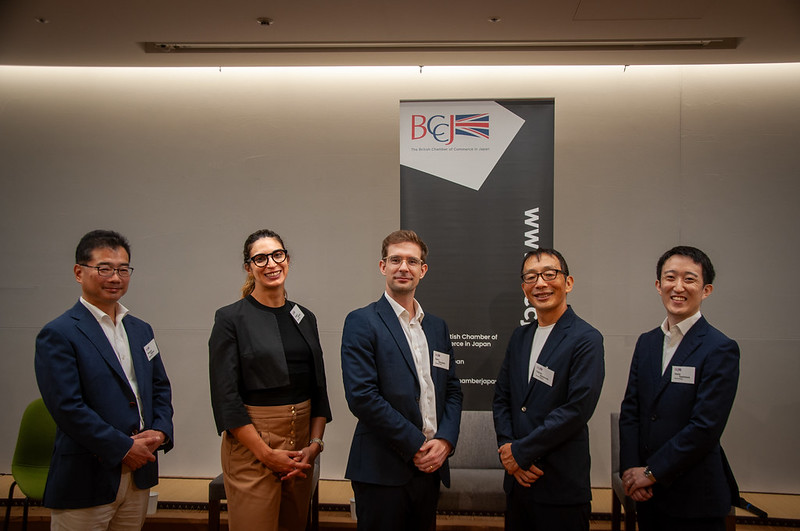
Against this backdrop, the British Chamber of Commerce in Japan assembled an expert panel in Tokyo to consider how Asia’s second-largest economy can achieve its net zero targets as part of a cleaner and greener future. Moderated by Harry Dempsey, Tokyo correspondent for the Financial Times, the speakers comprised Hajime Nakamura, CEO of Octopus Energy Japan; Virginie Sandilya, Department Head of Project Finance at Shizen Energy; Takayuki Shibata, Lead Partner at ERM Nihon KK; and Kento Yoshimura, Head of Japan at Aurora Energy Research.

Renewables development
Yoshimura said Japan’s renewables’ share has risen from around 10% in 2023, yet there were challenges to further growth, including inflation.
Sandilya said a key challenge was 'how to mobilise the private sector,' noting: 'The public sector can’t do this alone; how can we have structures for investors to invest in Japan more and help achieve its targets?'
Nakamura described technology developments as vital, including the development of new solar cells, lower battery costs and more offshore wind projects. Shibata stressed the need for demand-side management but added that 'even more sophisticated technology will be required' to do so.
In the UK, Octopus Energy’s electric vehicle tariff Intelligent Octopus Go is reportedly used by more than 200,000 customers, helping to reduce EV charging costs. Nakamura said the company is using its AI-powered platform Kraken to build 'flexible' services for Japanese clients.
Considering batteries, Sandilya said they have been the 'missing link' in Japan amid the growth of renewables, noting: 'We’re now at the beginning of the journey; the government went through two rounds of the decarbonisation auction, which was hugely successful and oversubscribed. This showed that there is high interest from the market to invest in batteries, and with government cash flows, it’s an easy solution, at least for investors.
'The only difficulty is that it’s a capped capacity. So, on the investor side, we’re looking for other solutions outside of the auctions through the private sector to find arrangements to firm up revenues,' she added, noting that Shizen Energy is expecting lower prices and higher subscription rates from the next round of auctions.

Data centres
The AI boom has led to a surge in demand for data centres, boosting the electricity needs of technology giants such as Amazon, Google and Microsoft.
Sandilya said the development has boosted the corporate PPA (power purchase agreement) market, with Shizen Energy having already signed a 'virtual' PPA with Microsoft for a solar project in Aichi Prefecture, as well as another 'large scale' PPA with Google for a solar project at a former golf course located in the same power grid as Google’s data centre in Inzai, Chiba Prefecture.
'There’s a big question around AI and data centres on what this would do to energy consumption. And I think these companies, with their willingness to have an impact, can really bring solutions and help pay for the energy transition of Japan,' she said.
However, Nakamura said the 'hardest bottleneck for the development of data centres is to get approval for access to the grid,' adding, 'I have heard that some data centres are considering temporary alternatives such as gas-fired generation. Once more offshore wind comes to the market, they may switch.'
Shibata pointed out that Japan requires a different approach to the United States, where many data centres are powered by a nuclear or other power plant nearby. In Japan, regulation means every data centre must receive its power via the network. 'If they would like to access the network system, they must ask the retailer, who has to accept it,' he explained, adding that this issue is affecting growth of the data centre business nationwide.

The grid
Asked about the evolution of Japan’s power grid, Yoshimura pointed to the need for greater interconnections to deliver green power from areas such as Hokkaido (for wind) and Kyushu (for solar) to demand centres in Tokyo, Chubu and Kansai.
'When we talk about a green transformation, it is important to increase renewable energy use in the context of the power system … the interconnection line is important,' he said, adding that the government continues to update its plan to build the grid in the long term.
Sandilya said there are 'still plenty of good sites around Japan to develop solar,' citing the reuse of former golf courses and abandoned farmland as examples. She emphasised that such land allows for the reuse of existing resources while minimising environmentally intensive practices such as large-scale tree cutting or land alteration.
'The main difficulty is community engagement; the perception of converting agricultural land into a solar farm can be a sensitive topic,' she said. 'We therefore place the highest importance on meaningful dialogue with local communities, explaining what we do, how we can create local value, and ensuring we limit impacts on biodiversity.'
Perovskite solar cells are seen as a potential technological innovation for solar power, but Nakamura said the technology is still 'very much in the developmental stage' despite support from the Japanese government.