Event Recap: Sustain the Chain: Rethinking Global Supply Chains in 2026
As a follow up to the BCCJ Global Forecast 2026 event, 'Sustain the Chain: Rethinking Global Supply Chains in 2026' explored how increasingly complex geopolitical tensions and global uncertainties are exposing the fragility of supply chains, and addressed how organisations can respond with resilience, agility and adaptability.
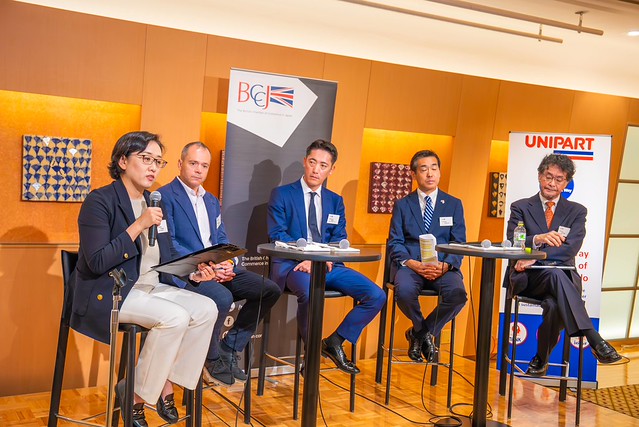
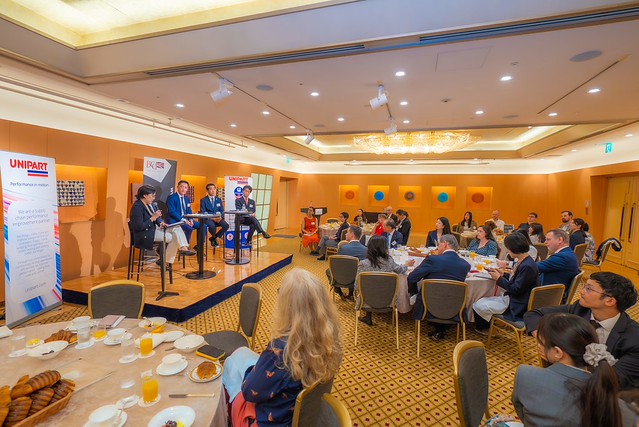
An expert panel discussed how Japan—a major manufacturing economy reliant on maritime trade routes and deeply embedded in Asia-Pacific supply networks—faces both significant exposure and strategic opportunity, as well as how UK-connected businesses operating in the country can navigate that tension as a boardroom priority.
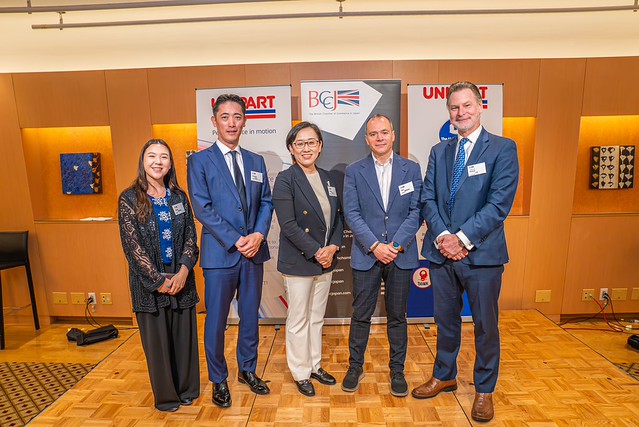
The speakers were Satoshi Inomata, Chief Senior Researcher at the Institute of Developing Economies, Japan External Trade Organization (IDE-JETRO); Yasuhisa Okamoto, Managing Director of Drax Asia Japan KK; Yasuhiro Saito, Executive Officer, CIO/CDO at Yamato Holdings Co., Ltd; and Carl Williams, Managing Director, Asia Pacific of Unipart, with moderation by Kumiko Pivette, Director of Geopolitical Risk Advisory at PwC Japan LLC.
Tools for risk management
Inomata delivered a keynote on understanding trade flow data and regional risk mapping amid the evolving shape of supply chains in the Asia-Pacific region.
Recent surveys indicate many organisations are inadequately prepared for shocks to their supply chains, he explained. For example, companies expressed less awareness of the operational status of their suppliers and customers farther and farther upstream or downstream in their supply chain, despite studies revealing serious incidents are more likely to occur with high frequency at distant transaction points such as tiers three and four.
To tackle this gap, 'supply chain mapping should be done in a holistic manner using network approaches,' he said, pointing to two datasets: the FactSet supply chain database, which tracks business linkages for more than 600,000 companies globally, and input-output (I-O) tables, which represent an economy by depicting all monetary transactions of product flows between industries in a single matrix.
FactSet data identifies various types of connections, such as exclusive vendors, distributors and strategic partners; allows users to trace dependencies far up and down their supply chains to discover hidden risks and vulnerabilities; and provides relationship metadata including revenue dependence and relationship relevance.
I-O tables, meanwhile, map the 'who sells what to whom' of an entire economic system, detailing the journey of goods and services from production to intermediate and final use.
These resources were combined to form a novel analytical tool, the Risk Exposure Mapping (REM), a quantitative framework designed to measure global supply chain vulnerabilities to geopolitical shocks such as trade wars or economic coercion, he continued. This new instrument on supply chain vulnerability features production networks covering more than 2.3 million transactions globally.
Recent impacts on supply chains
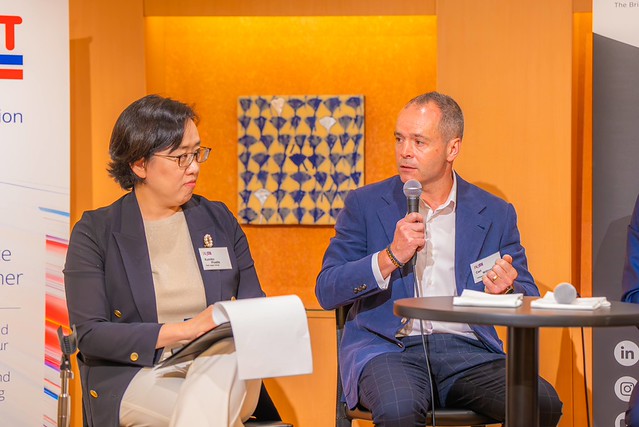
Opening the panel discussion, PwC Japan’s Pivette noted that supply chain disruption today 'is not simply a sequence of isolated shocks but a deeper shift in the operating environment—one that is changing due to geopolitical fragmentation, industrial policy, cyber risk, maritime insecurity and growing pressure for visibility across the supply chain.'
She asked the panellists where and how supply chains are most impacted, what building resilience means in practice and what organisations and economies can do to perform well amid uncertainty.
Yamato’s Saito said his industry—logistics, express delivery and supply chain—has been transformed since the Covid pandemic, when many companies introduced nearshoring to bring their products closer to their customers. Some of Yamato’s UK-based customers, which sell items like protein bars to Japan, established facilities in Singapore. Now, amid geopolitical uncertainty in the Middle East, it’s vital that companies again source reliable information to make informed decisions, he added.
Another significant change in the past few years has been the shift from just-in-time (JIT) to just-in-case (JIC) supply chain management, explained Unipart’s Williams. While the JIT approach was highly efficient, quick and low cost, JIC can involve more inventory, longer lead times and less customer satisfaction, albeit with risk mitigation.
Still, utilising JIC as 'an interim stepping stone' until an organisation’s supply chain is redesigned to make it more flexible and less dependent on certain groups or areas can be 'a decent long-term strategy,' he continued. What is critical for companies, he added, is 'making conscious decisions regarding the supply chain.'
For Drax Asia (Japan), which supplies sustainable biomass to Japan and the wider Asia region, supply chain resilience is key, explained Okamoto. Around 90% of Japan’s biomass is shipped in from overseas, mostly from the United States and the Middle East. Amid the ongoing Iran conflict, the company is grateful for nations such as Canada, which is permitting bunkering (refuelling) of Drax vessels in one of its west coast ports.
Okamoto agreed that such agreements with 'friendly countries' are important for energy security, noting that Japan supplies crude oil to several southeast Asian nations. Furthermore, in response to severe supply disruptions in the Middle East and the closure of the Strait of Hormuz, Japan has secured more than 70% of its crude oil needs from alternative sources. 'Japan has the third-largest fleet in the world and shipping plays an important role in the Japanese economy,' he said. 'Japan can make a big contribution to Asia in the shipping field.'
Proactive approach
Asked how organisations can increase their supply chain resilience, Unipart’s Williams said one component is creating a fluid cyber policy that outlines a plan for business continuity if the organisation is attacked. Collaboration with suppliers and vendors during the process is key, he continued; 'doing it in isolation won’t solve challenges.'
In energy supply, Drax’s Okamoto emphasised the need to diversify sourcing across multiple countries while assessing the supply risks associated with each and identifying preferred sourcing countries. This system would protect essential operations by buffering against shortages, volatility and geopolitical friction.
'We should be able to pay a small premium [to high priority countries] to secure a stable supply,' he explained, adding that companies should, in parallel, 'work together with other companies and government to mitigate risk.'
Yamato’s Saito said organisations that learn how to manage data, particularly through supply chain management databases, will be most successful in improving their supply chain resilience.
Ongoing development of such databases will provide 'better visibility, transparency and traceability,' said IDE-JETRO’s Inomata, who called for greater public-private cooperation in the field.
'Information from private firms can be collectively integrated to give a big picture and harness views on where potential vulnerabilities exist. Procurement is a top business secret; government should secure anonymity so private firms have safe disclosure. This is particularly important for SMEs and unlisted companies that are generally not covered by open-source data. Researchers should also be given proper access to databases for intelligence collaboration,' he said.
Looking ahead, Williams opined that the future looks bright for companies due to the growing pool of graduates with specialist degrees in supply chain management. In the UK, for example, more than 70 universities offer programmes in the discipline at undergraduate and postgraduate level.