
Event Recap: The New Space Economy - Japan In Focus

Produced and written by Sterling Content.
With national governments increasingly prioritising space for national security, economic growth and modern communication, the sector presents growing opportunities for businesses.
In the UK, as of July 2026, British companies, universities and researchers have access to £62 million in government funding to develop homegrown space technologies. Japan, meanwhile, has the Space Strategy Fund, a ¥1 trillion initiative managed by the Japan Aerospace Exploration Agency (JAXA) to provide research and development support to companies, startups and universities to double Japan’s domestic space market to ¥8 trillion by the early 2030s.
Amid this backdrop, the British Chamber of Commerce in Japan (BCCJ) held the event 'The New Space Economy' with support from event partners the British Embassy Tokyo, the Department for Business and Trade, the UK Space Industry and Clifford Chance. Members and guests were joined by a delegation of 19 British firms visiting Tokyo for SPACETIDE, a commercial space conference that envisions 'unlocking space for all humanity.'
Harriet Loos, Head of Trade at the British Embassy Tokyo, set the scene for attendees by outlining the growing work by the British and Japanese governments on space. One example is the UK–Japan Frontier Technology Partnership, designed to deepen bilateral collaboration in artificial intelligence, quantum technology, semiconductors, cyber security and space.

'Our countries recognise that space is critical to how our economies function, how our societies stay connected and how our nations maintain their security,' she said, noting that British and Japanese companies are working together in satellite services, earth observation, in-orbit servicing and space sustainability, with 'enormous potential to expand these partnerships.'
The UK’s Defence Investment Plan, published in June, commits more than £8 billion over the next four years to the Global Combat Air Programme, a partnership between the UK, Japan and Italy to build a sixth-generation stealth fighter jet by 2035, 'underlining our long-term commitment to developing advanced capabilities that will help secure both the Euro-Atlantic and Indo-Pacific regions,' she added. Many of the technologies being developed have future defence applications, from AI to advanced sensors, with increasingly important links to the space ecosystem.
Japan’s approach to space
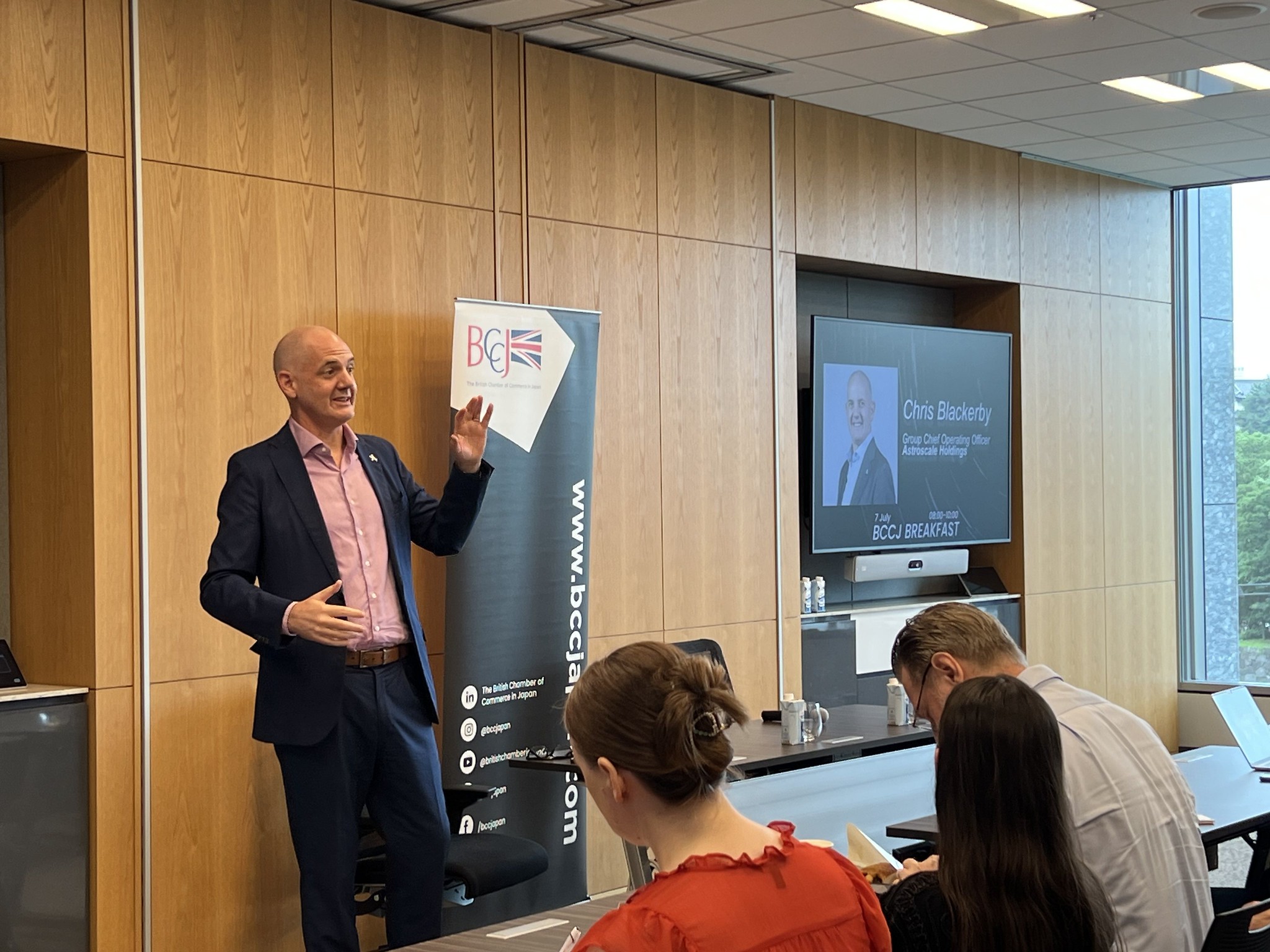
Chris Blackerby, Group Chief Operating Officer at space venture Astroscale, explained that Japan has historically focused on the civil side of the space sector, notably exploration, earth science and space science. Since the late 1960s, activity has been led by JAXA (formerly NASDA), with cooperation from the US and large domestic aerospace companies.
For the US, however, space and defence have long been connected, he said, noting that 11 of the 12 astronauts who first stepped on the moon had military backgrounds.
Sentiment began to change in Japan in 1998, when North Korea launched a missile over the country, prompting the government to seek greater awareness of these threats. The result was the launch of the Information Gathering Satellite programme, which provided basic observation from space to show what was happening on the ground. In subsequent years, Japan began paying more attention to defence policy.
According to Blackerby, other watershed moments include 2013, when the first US–Japan Comprehensive Dialogue on Space began, and 2015, when SPACETIDE was founded, resulting in startups, including from overseas, entering Japan’s space ecosystem in greater numbers. Large companies responded by trying to partner with startups or by launching their own offshoots related to space, changing the dynamic in the sector.
Now the Japanese government is prioritising expansion of its commercial space ecosystem, as well as strengthening of space security and situational awareness. Space operations are to be added to the fold of the Japan Air Self-Defense Force when it is renamed the Japan Air and Space Self-Defense Force in fiscal 2027.
Although the sector is nascent, Blackerby said investment opportunities in Japan have reached par with Europe, evidenced by growing interest in the sector, including from companies that have established space groups within their funds.
'We see a change,' he said. 'There is an understanding that there is money to be made in space, and investment is following that.'
The environment presents opportunities for foreign companies to enter the market, he added, but noted pitfalls such as export controls due to sovereignty issues, as well as cultural and linguistic challenges.
Case study of a startup
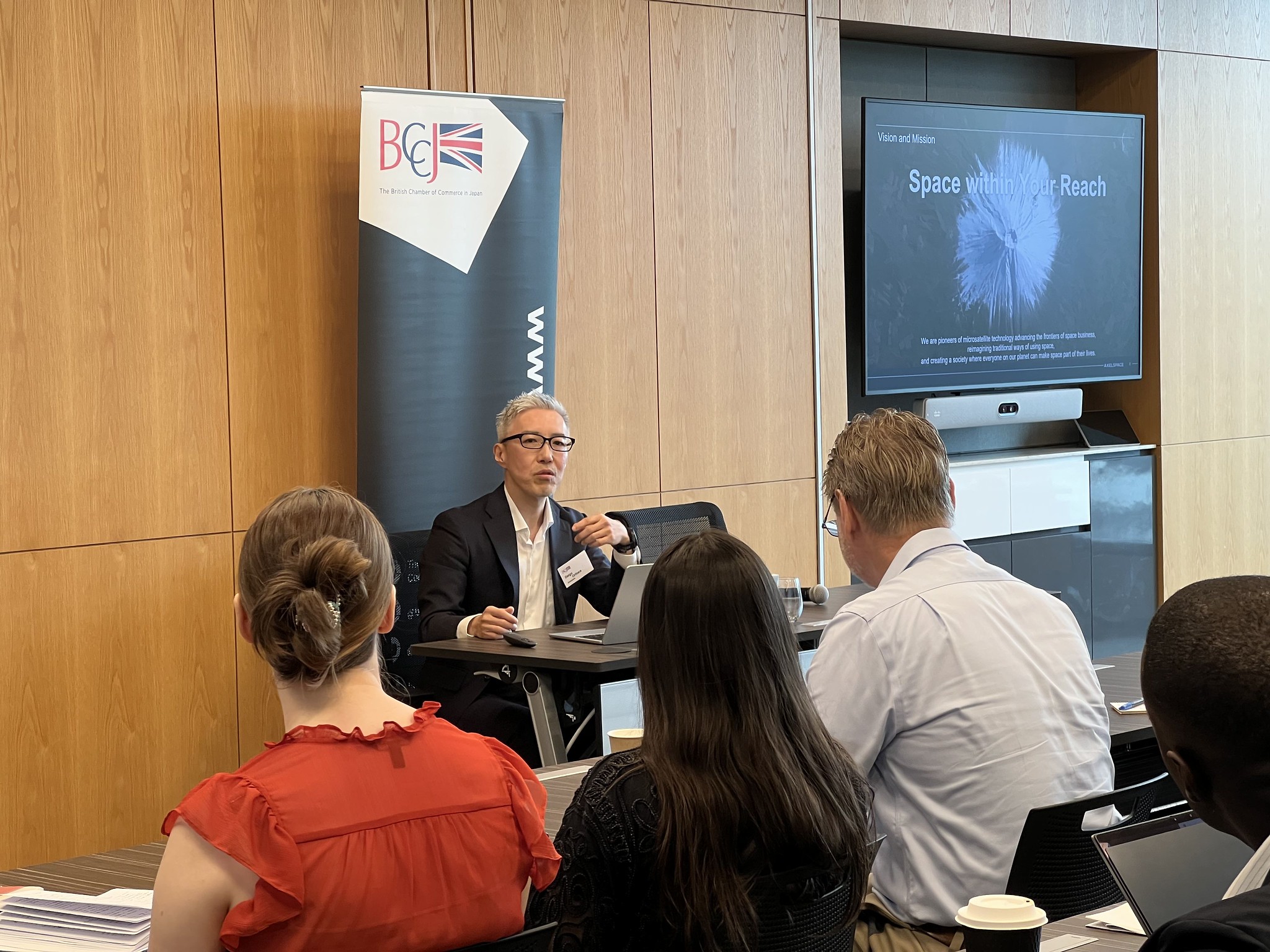
Daigo Orihara, Chief Operating Officer at Axelspace, introduced how his space venture has developed since its establishment in 2008.
The founders, who were university graduates, believed that leveraging micro satellite technologies could make space accessible to society. Today, the company has more than 200 employees from 25 countries operating two business lines: AxelLiner and AxelGlobe.
AxelLiner is a one-stop satellite development and operations service that builds, launches and manages custom space missions. Its in-orbit demonstrations are provided by ride share, reducing costs for companies that require their components to be tested in space conditions before they can be sold for use in space. It involves the development and demonstration of inter-satellite optical communication network systems for building global space communication infrastructure.
AxelGlobe is a commercial Earth observation platform that provides high-frequency satellite imagery and data insights to global industries.
Axelspace was the first Japanese startup to receive a contract from JAXA for satellite development, and has designed, manufactured and launched 11 microsatellites since its establishment. A further seven microsatellites for Earth observation were launched successfully following the BCCJ event.
The company is participating in Japan’s K Program, an economic security initiative, to develop and demonstrate cutting-edge inter-satellite optical communication network systems, and in the Ministry of Defense’s ¥280 billion Satellite Constellation Project as the sole provider of optical imagery using specialised microsatellite technology.
Looking at growth opportunities, Orihara cited Japan’s defence capability enhancement plan for fiscal 2026 as an example of the Japanese government’s intensifying interest in the space sector.