
Event Recap: Global Forecast 2026

Geopolitical tension, economic recalibration and policy shifts are influencing capital flows, trade dynamics, regulatory direction and corporate decision-making as organisations map out their priorities for the next 12 months. And understanding how international developments translate into local impact is critical for organisations to protect their investments, manage exposure and identify opportunities.
That’s why expert voices in economics, policy and strategic advisory came together at the British Chamber of Japan event, Global Forecast 2026, to provide clarity and context on the increasingly complex geopolitical and economic climate, empowering business leaders to navigate their UK-connected operations in Japan in the new fiscal year.
The speakers were Jesper Koll, Expert Director for the Monex Group and the Japan Catalyst Fund, and Neil Newman, Head of Strategy at Astris Advisory Japan, with moderation by Heather Prosser, Partner at FGS Global, Japan.
Geopolitical challenges

Koll set the scene for attendees by pointing out one of the biggest changes in global geopolitics: 'the post-war regime has come to an end … and the nation state is more important than anything global.'
Alongside this shift, the Trump administration in 'asserting the dominance' of the United States over the world, including in digital, payment structures, the economy and geopolitics, he said.
The result has been increased populism, uncertainty and economic pressure on the middle and working classes. Still, 'Trump is a symptom, not the cause' of the overall decline in the income of global citizens, which has been ongoing for the past 20 years, Koll said, noting that the US elite is likely to continue being 'defensive of their own vested interests rather than operate in the best interest of the people.'
Japan, on the other hand, he continued, is 'a model of capitalism that actually works … with the best functioning social economic system in the universe.' What’s more, 'in a very uncertain world, Japan is ambitious, a bastion of stability and extremely confident,' he added, noting strengths such as Japan’s soft power, strong IP and ability of its listed companies to increase profits despite flat toplines.

Even amid the country’s declining population, he remains positive, noting that 'scarcity is the mother of innovation.' In academia, for example, Japan has potential and merely needs to change its incentive structures to continue delivering cutting-edge research and development. He cited a ¥10 trillion endowment fund set up three years ago by the government to provide grants to scientists. The uptake of this financial assistance has been limited due to the requirement for interdisciplinary work, which Koll said Japan needs to improve upon, alongside a better transfer of technology so research can be commercialised.
Japan is also prepared for a possible energy and food shortage, as the government would utilise a supplementary budget 'to ensure the purchasing power of people will not be eroded,' he said.
Japan’s dependence on the US, however, is problematic, particularly for financial markets as around 70% of Japanese companies’ profits are generated abroad. Also, a quest for companies to act as 'national champions' has resulted in too much competition at home as well as government support to maintain 'zombie companies' that otherwise could not operate.
Koll called on attendees to 'help Japan find its focus of core competence and targeted innovation to create regional and national champions' and to 'be more bullish on Japan,' pointing to its focus on self-reliance while possessing the capital, technology and resources to succeed.
Economic tailwind
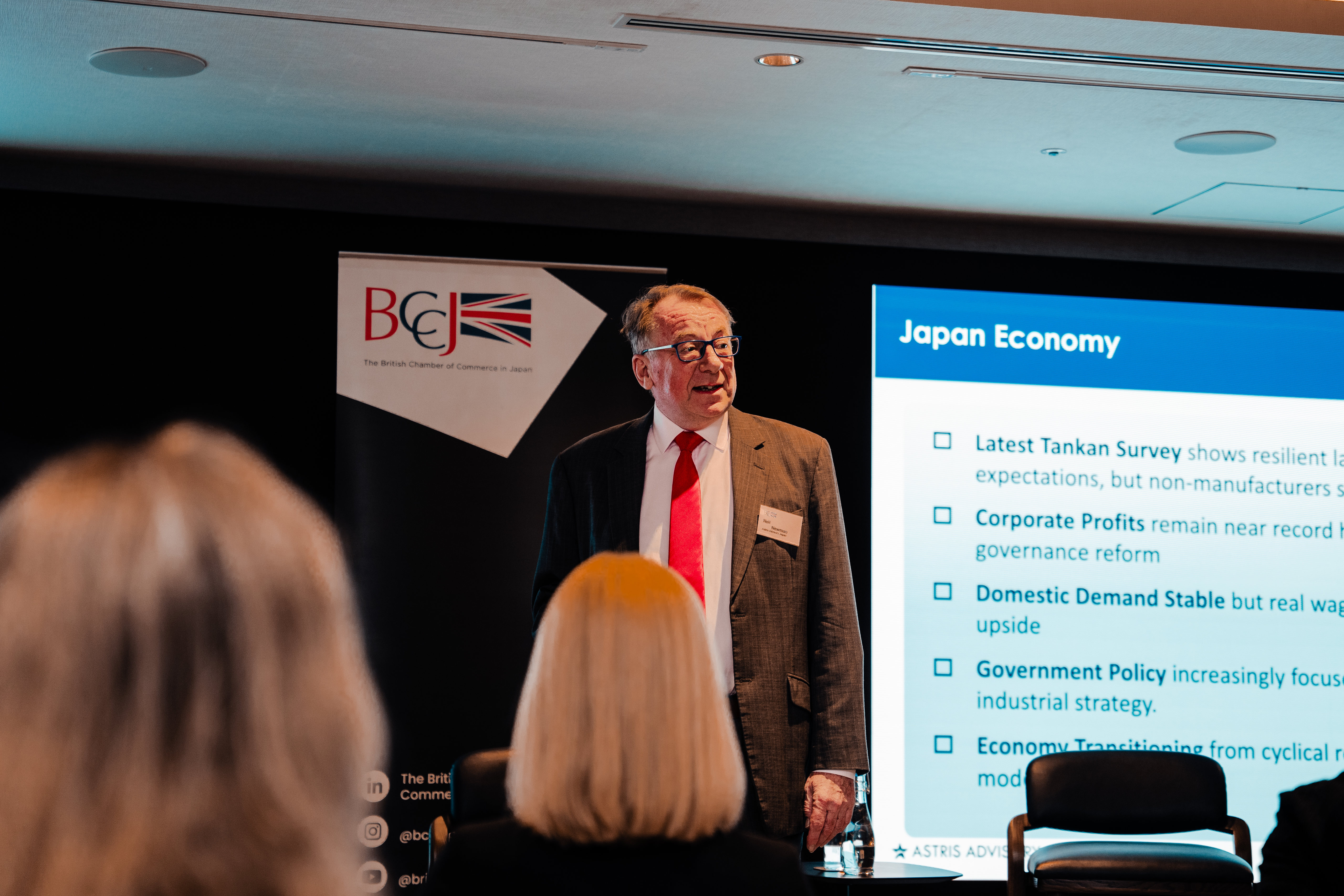
On the economy, Newman noted Japan’s transition from recovery to growth. Corporate profits remain near record highs, supported by pricing power and governance reform. The Bank of Japan’s latest Tankan Survey (a short-term economic survey of enterprises in Japan) shows resilient large manufacturer sentiment while non-manufacturers are softening on cost pressures. Domestic demand is stable but real wages still lag inflation, limiting consumption.
Investors are increasingly focused on Japan’s priority sectors, such as energy security, which the government considers vital 'in order to mitigate risk,' he said. Three nuclear reactors have been restarted in the first quarter of this year, and work is ongoing to consolidate the nuclear industry in order to reduce costs.
Still, this boost to Japan’s energy security is diminished by the rising cost of Brent oil due to the Iran conflict. If the war is over in a month or two, the impact on Japan will be relatively limited as the country holds oil in reserves, but if the war is prolonged, the damage to Japan could be more pronounced, he explained.
Newman predicted an increase in interest in Japan this year, as evidenced by the uptick in the number of investors and businesses entering the market. On the whole, Japan is 'very resilient,' with 'its own microclimate,' which makes it attractive for business.
'Japan has the ability to build out relationships, particularly in Asia and the UK,' he said. 'Japan wants energy security, AI and technology … so there’s a lot of opportunity for the UK.'
With the yen trading around ¥158 to the US$, driven by factors such as rate differentials and energy import costs, exporters are benefiting but consumers and importers are feeling some pressure, he noted.
However, a strengthening yen would not result in a negative impact on corporate earnings, even though Japan has been selling more goods and services to overseas markets than to the domestic market since around 2013, he continued. Rather, 'import costs would come down, input costs would come down, and Japanese companies would make more money,' he said. 'We would see a burst of corporate earnings, which would attract more investment into Japan.'