
Event Recap: In Focus Series: UK–Japan Relations

Written by Sterling Content
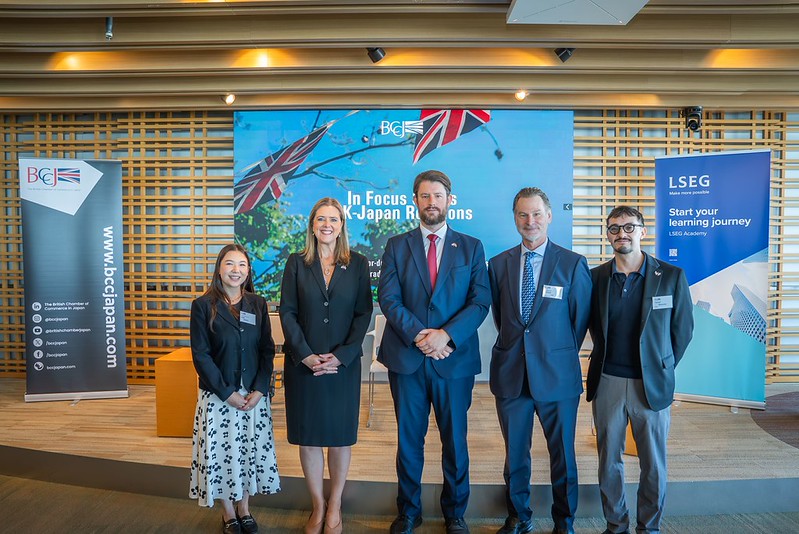
Ambassador-designate to Japan Corin Robertson CMG and UK Trade Envoy David Taylor MP joined the BCCJ for a members-only fireside chat about the growing cooperation between the UK and Japan across trade, investment, security, innovation and people-to-people ties.
As both individuals were appointed to their positions this year, the event also explored their early reflections on the roles, as well as the opportunities, challenges and priorities likely to define UK–Japan engagement in the years ahead.
Steve John, chief corporate affairs and marketing officer at the London Stock Exchange Group (LSEG)—the event’s supporter—welcomed attendees to LSEG’s Tokyo office.
'The relationship between the UK and Japan is built on much more than trade. It is strengthened by deep cultural ties, mutual respect and shared strengths in areas including finance, technology and innovation,' he said. 'We see the strength of that relationship first hand. Japan is a critical market for our business; we serve more than 1,000 customers here and 90% of our revenues in Japan come from domestic customers.'

Deepening relations
Robertson, who is serving at the British Embassy Tokyo for the second time, following her 1996–2000 post as second secretary, also noted the strengthening of the UK–Japan relationship in recent years. This is important, she continued, because the world is increasingly complex, as evidenced by recent geopolitical uncertainty, conflict, economic pressures and exponential technological change.
'It’s pushed us even closer together because we’re two partners who are likeminded in terms of our values and our approach to the rules-based international system, and we have huge complementary strengths in our economies around innovation, research, institutions and ideas,' she explained.
The UK is a leading economy in financial and professional services, life sciences, AI and tech while Japan offers cutting-edge skills in robotics, industrial processes and manufacturing. Across all of the fields and more, the UK and Japan are increasing trade and investment opportunities.
In addition, the UK is working 'in the most sensitive sectors of its economy with Japan, building shared abilities and shared sovereign capabilities together,' Robertson said, describing the move as a 'big shift' in relations.
Asked about her goals in her ambassadorial post, Robertson said she hoped to see the real impact of the work the UK and Japan are doing together 'for both of our countries in security, resilience and growth.'

Bilateral collaborations
Robertson and Taylor outlined the wealth of UK–Japan-related business activity, from renewable energy development in Scotland to manufacturing at Nissan Motor in Sunderland.
In Coleraine, Northern Ireland, Kyoto-based Kyocera Corporation’s subsidiary Kyocera Avx is making advanced ceramic capacitors and switch-mode power supply components designed for extreme environments. The plant has even produced capacitors used in NASA’s Artemis missions to the moon.
At Fukushima Daiichi’s Unit 2 reactor, meanwhile, the remote-controlled robotic arm deployed for fuel debris retrieval was co-developed with Veolia Nuclear Solutions at its Oxfordshire technology centre alongside Mitsubishi Heavy Industries and the International Research Institute for Nuclear Decommissioning.
In food and drink, 90% of the UK’s blackcurrants—around 10,000 tonnes a year—are used by Suntory to make the popular drink Ribena. And at Niigata Kameda Distillery in Niigata, founded in 2019, custom copper pot stills made in Scotland and British malted barley are being imported to make its craft whiskey.
The pair also pointed to the many collaborations involving universities and industry. Ulster University, for example, is working with companies like Kyocera to develop a pipeline of talent and research capabilities. Toyota Manufacturing UK and the University of Derby, meanwhile, are undertaking a feasibility study for a next-generation, lightweight battery electric vehicle, designed to help make cities cleaner, smarter and more accessible.
Top-level progress
Robertson said the large number of partnerships signed between the UK and Japan demonstrate the 'fantastic momentum behind the relationship.' These include the Industrial Strategy Partnership, announced in 2025, which outlines 'the huge commonality of sectors and a plan for growth over the next 10 years.' The plan includes activities in the fields of advanced manufacturing, automotive, clean energy, life sciences, quantum and cyber.
Most significant is the Hiroshima Accord, a landmark UK–Japan strategic partnership signed in 2023 in Hiroshima, ahead of the G7 Summit. With work nearing completion on the accord’s key pillars, including defence and security; science, technology and semiconductors; trade and economy; and climate and energy, officials in both countries have been tasked to look at a new bilateral framework, she explained.
As the two largest economies in the Comprehensive and Progressive Agreement for Trans-Pacific Partnership, Japan and the UK have 'a real opportunity to shape the world and the rules-based system,' she added.
Furthermore, the UK assumes presidency of the G20 in 2027 and the G7 in 2028. As climate and climate resilience is the theme of the G20, it is likely that one focus area will be energy transition. The international forum also presents opportunities for parallel events with business leaders, such as the B20.

Grassroots business
Part of the British government’s role in supporting trade and investment includes helping the Japanese government provide stability and clarity for doing business and providing Japanese investors in the UK with greater support to navigate the various types of support available.
As trade envoy, Taylor facilitates conversations and supplements the work of the teams at the British Embassy Tokyo and British Consulate-General Osaka who are helping British companies access the Japanese market, navigate operational challenges and grow.
Based in the UK, he has hosted Japanese delegations in London and also spent time in Japan meeting companies, including in life sciences, renewable energy and defence.
One of his priorities is ensuring the Global Combat Air Programme, the trilateral defence initiative led by the UK, Japan and Italy to develop a combat air system by 2035, is on track while exploring opportunities in other joint defence ventures.