
Event Recap: The Business of Real Estate
Written by Sterling Content
The trends, challenges and opportunities in Japan’s real estate landscape were the focus of the British Chamber of Commerce in Japan’s event, 'The Business of Real Estate,' hosted by event partners Jones Lang LaSalle (JLL) and the Royal Institution of Chartered Surveyors (RICS).
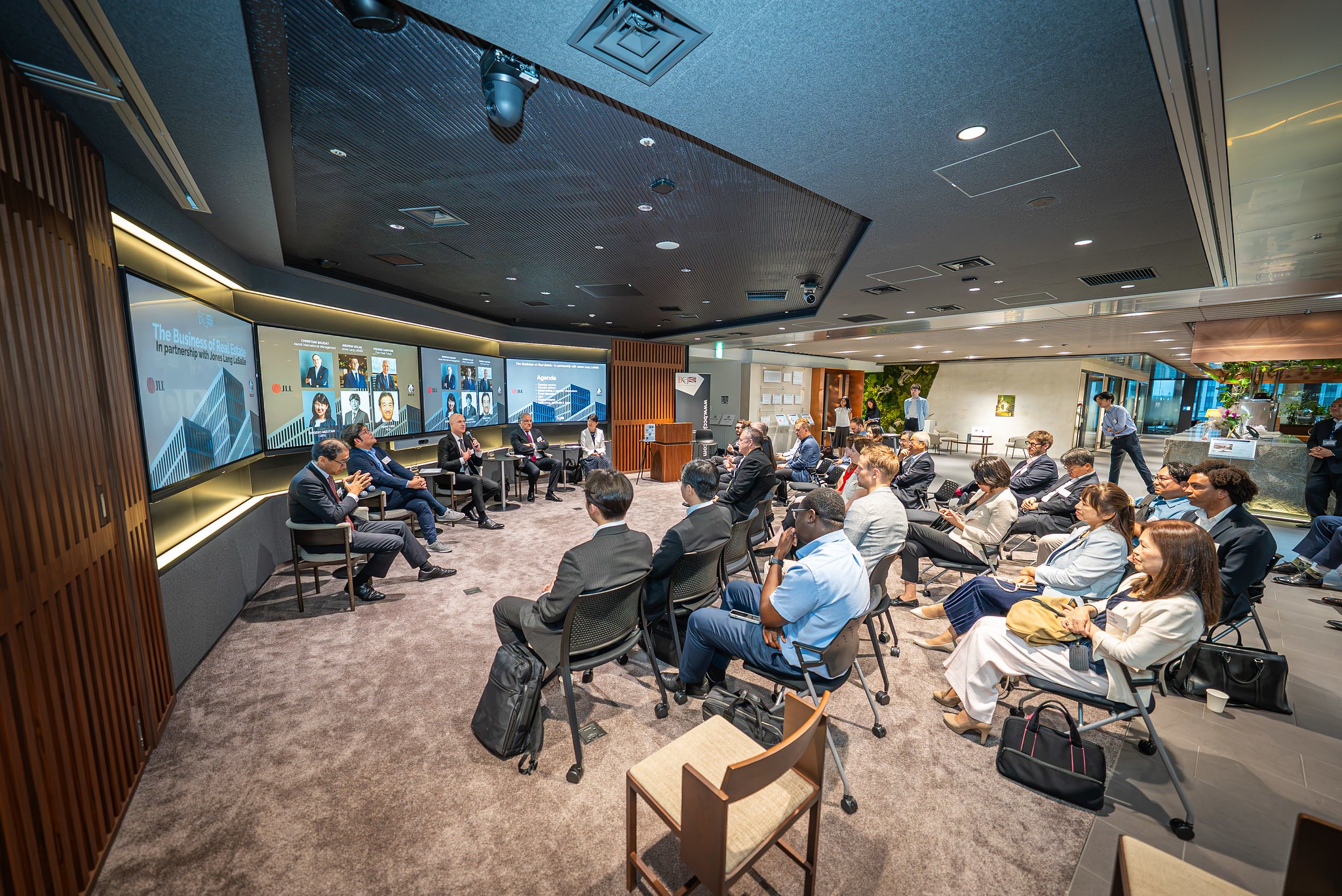
Comprising a keynote and a panel discussion, the session examined the forces reshaping Japan’s real estate, from changing investment patterns and sustained growth in tourism, to construction costs and labour shortages, and what they mean for businesses operating across the country.
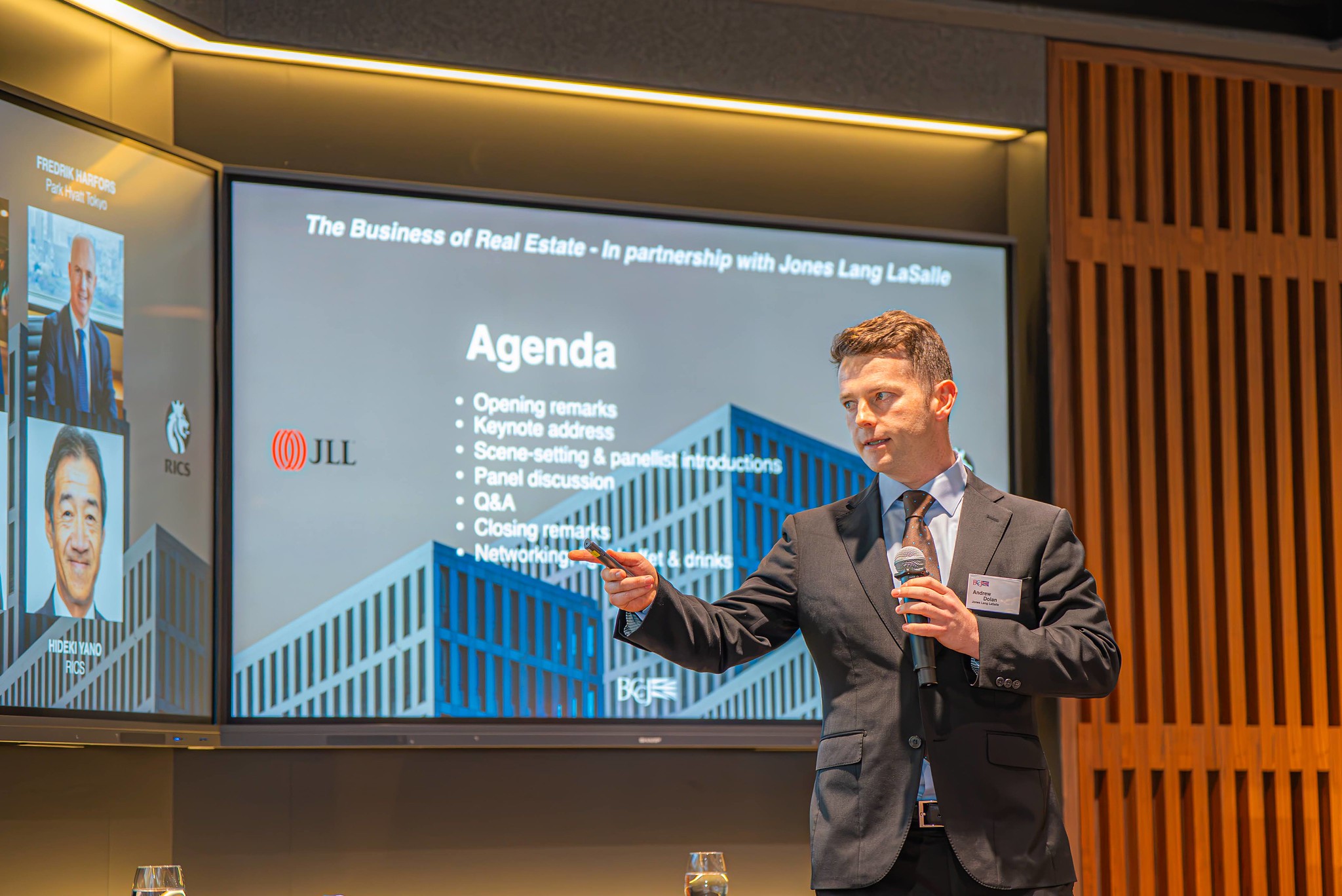
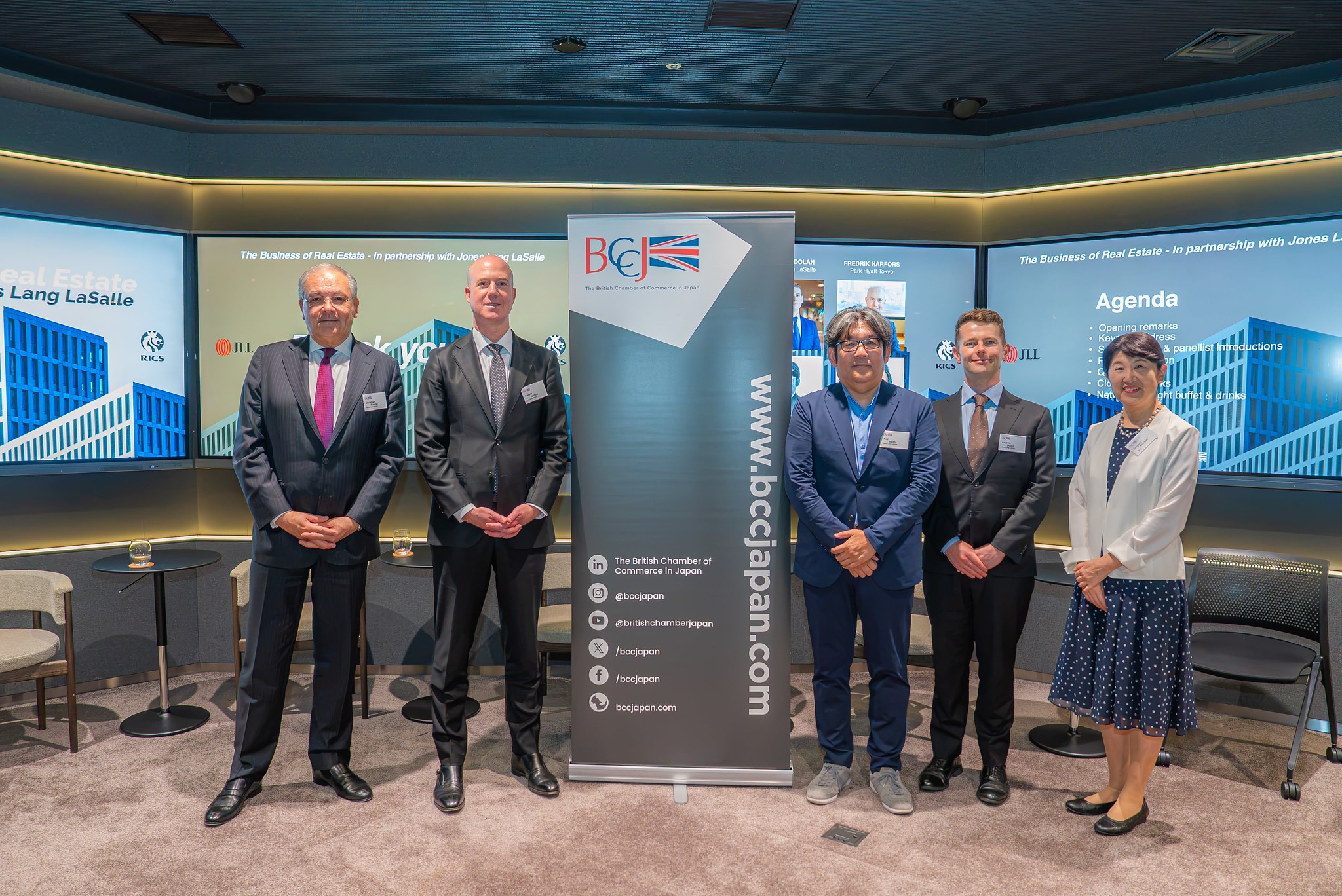
The speakers were Andrew Dolan, Director of Industrial & Data Center Capital Markets, Japan & Korea, JLL; Christian Baudat, Country General Manager & Representative Director of Ascott International Management Japan Company Limited; Fredrik Harfors, General Manager at Park Hyatt Tokyo; Koji Naito, Director of JLL; and Hideki Yano of RICS Japan, with moderation by Shigeko Mizutani, Managing Director, Valuation Advisory & Consulting Services of CBRE.
Market conditions
Dolan provided an introduction to Japan’s real estate market, looking first at liquidity. The US is the top destination for direct commercial real estate investment globally, with $104 billion in transactions as of Q1 of 2026, far ahead of Japan in second place, with $13 billion, and the UK and Singapore in third place, both with $12 billion. Still, the Asia-Pacific region saw the highest growth in investment volume in the same period.
Japan is highly attractive because of its 'large economy, highly educated population and deep market' that enable investment into multiple cities across the country, he said. And despite the Bank of Japan raising its short-term policy rate in June to its highest level since 1995, capital values are the same or increasing due to the very tight office market.
Yano agreed that Japan’s popularity for real estate investment is high, thanks to government transparency, political and social stability, and the diversity and scale of the market, with its many asset classes. The country is also friendly to foreign capital, with no stamp duty unlike others in the region, such as Hong Kong.
Of those investing in real estate in Japan, 30% are foreign investors but Dolan predicts that ratio will increase amid the geopolitical uncertainty in the Middle East.

Offices
Office vacancies in Japan were the lowest in the Asia-Pacific region in Q1 of 2026 at 0.7%, compared to 4.3% for Seoul and 17.4% for Sydney. Across the country, low supply and a strong return-to-office trend are driving up rents, which are forecast to grow at a compound annual growth rate of 7.1% over 2026–2030.
JLL’s Dolan attributed the high demand to Japanese culture’s presenteeism that encourages working at the office and the smaller size of residential spaces that make home offices difficult.
For Grade A office buildings in Tokyo, the vacancy rate is even lower, at 0.2– 0.3%, which is good news for investors, added JLL’s Naito.
'Most Grade A occupiers in Tokyo would like to expand their office spaces, not only due to business expansion but also as an investment to increase the engagement of their workers,' he said. In one case, a company saw a return-to-office ratio for its staff of 85–90%, up from 65–70%, following a move to a more sophisticated office.
In addition, many Japanese companies opted for half of their workforce to work from home during the pandemic, increasing the space per capita in the office. Now, those offices tend towards full occupancy, making them feel cramped.
With new Grade A office supply limited over the next three years, demand is also rising for Grade B buildings, resulting in 'a bright future' for the sector, he said.
Hospitality
Booming inbound tourism, as evidenced by record arrivals of international tourists since the country’s post-pandemic reopening in October 2022, is providing a tailwind to Japan’s hospitality sector.
'Japan is on everyone’s bucket list at the moment … and its popularity should give developers confidence,' said Park Hyatt Tokyo’s Harfors. 'Overall, occupancy rates are very high. We’re seeing that guests are staying longer, especially if they’re coming for the second or third time.'
Furthermore, with the government goal to welcome 60 million international visitors annually by 2030, there is no sign of slowdown, with Harfors reporting 'immense appetite for hotels, from full-service to select-service properties.'
Ascott International Management is also seeing growing interest in hospitality assets, including from new entrants to the sector such as Airbnb-style accommodation, Baudat noted. Demand is increasingly shifting towards accommodation with residential-style facilities that support longer stays, reflecting changing travel patterns and the growing preference for extended-stay options. These assets are also viewed as more resilient, given their flexibility to cater to both short- and long-stay guests.
'Ascott has experienced a rise in inquiries driven by the strength of its hybrid business model, which combines the benefits of hospitality and residential accommodation. At the same time, rather than pursuing new greenfield developments, many developers are focusing on conversion projects, including in secondary and tertiary markets,' he said.
The demographics of visitors is also influencing the market. Approximately 70% of inbound tourists are from other parts of Asia, with particular growth from India and Indonesia, driving demand for co-living and multi-family offerings that can accommodate larger groups. 'Everybody has an appetite for welcoming those tourists and having the type of efficient properties to cater to them,' Baudat continued, adding that hoteliers’ approaches range from bunk beds in rooms to tailor-made properties.
He predicts further expansion in the diversity of hospitality properties, as well as growth in upscale assets. Alongside a greater number of conversions will be an increase in transactions as investors are typically showing interest in keeping their accommodations for only 2–5 years, he added.

Opportunities and challenges
Asked where to invest in real estate, Naito said opportunities are concentrated in Greater Tokyo (70%) and Kansai (20%), particularly for the office market, but suggested Fukuoka had potential for residential assets. Nagoya, meanwhile, is home to the largest industrial asset market in the country.
For hospitality-related investments, Tokyo is still a key destination, added Ascott’s Baudat. Although Osaka has some oversupply following Expo 2025, it is also worth watching due to its recently improved infrastructure and upcoming integrated resort, scheduled to open in 2030. Resorts in secondary and tertiary cities, such as Niseko, Hakone and Okinawa, also have potential.
RICS Japan’s Yano said regional Japan is also promising for hospitality investors, given that using tourism to support regional revitalisation is part of the government’s growth agenda. Asked about the challenges facing the market, Yano cited inflation as a concern. Construction costs are increasing significantly, leaving investors unable to adjust accordingly and resulting in the postponement or cancellation of new projects. He suggested one solution is to move away from Japan’s traditional scrap and build model and extend the life of buildings through renovation.
Labour shortages, exacerbated by uncertain construction schedules, are also increasing the likelihood of delayed projects, while the weak yen is making Japan less attractive to construction workers from many parts of Asia, added Harfors. Furthermore, rising interest rates are putting pressure on developers’ profit margins.
In closing, Yano invited attendees to consider joining RICS, a globally recognised professional body that regulates and sets standards for professionals working in land, property, construction and infrastructure.
View photos from the Consular Briefing on our Flickr gallery!