
Event Recap: Both Sides of the Tax Equation
Written by Sterling Content.
In partnership with BCCJ members, Expat UK Tax, and HLS Global, we were delighted to welcome members to a timely session on tax. Focusing on a high-level breakdown of the tax landscape in 2026, topics covered Japanese corporate tax, UK tax obligations for overseas residents and Japanese income and inheritance tax.
Japanese corporate tax
HLS Global’s Tsujimura began by explaining that Japanese corporate tax applies to corporations, including joint-stock companies (KKs), limited liability companies (GKs) and some other entities, and is imposed on taxable income for each fiscal year. Foreign corporations are generally taxed on Japanese-source income. A final tax return is generally due within two months after the fiscal year-end, and a fiscal year may generally be determined by the company.
Japan’s corporate income tax consists of six types of tax: corporation, business, special business, inhabitant, local corporation and special defence corporate. The result of the 2025 tax reform, the Special Defence Corporate Tax must be paid by applicable companies from this fiscal year (starting April 1, 2026).
For the business tax and special business tax, different tax rates apply depending on whether the company has stated capital of more or less than ¥100 million. As part of the 2024 tax reform, the scope of corporations subject to the business tax was amended to include certain 100% subsidies from the fiscal years after April 1, 2026, with transitional relief measures available to mitigate the impact of the change, he continued.
Small and medium sized enterprises (SMEs) are generally companies whose stated capital is ¥100 million or less, excluding companies that are directly or indirectly wholly owned by one large company with stated capital of ¥500 million or more, or by two or more large companies within a 100% group.
SMEs can benefit from incentives such as a reduced tax rate of 19% on taxable income of up to ¥8 million, deductible entertainment expenses of up to ¥8 million annually and provision for bad debts. In addition, a further reduced tax rate of 15% or 17% may apply to fiscal years beginning on or before March 31, 2027.
Regarding entertainment expenses, companies with a stated capital of over ¥100 million and up to ¥10 billion may enjoy a 50% deduction of qualifying business meal expenses. For companies with a stated capital over ¥10 billion, entertainment expenses are generally fully non-deductible.
Companies approved to file blue-form tax returns may benefit from tax advantages including tax loss carry forwards, he said. The amount that can be deducted as tax loss carry-forwards from taxable income depends on the classification of the company and the fiscal year when the tax loss was incurred. It is possible for SMEs with blue-form tax return filing status to carry back a loss in the current fiscal year to one prior fiscal year and claim a refund of the corporate income tax amount to a certain limitation.
UK tax obligations for overseas residents
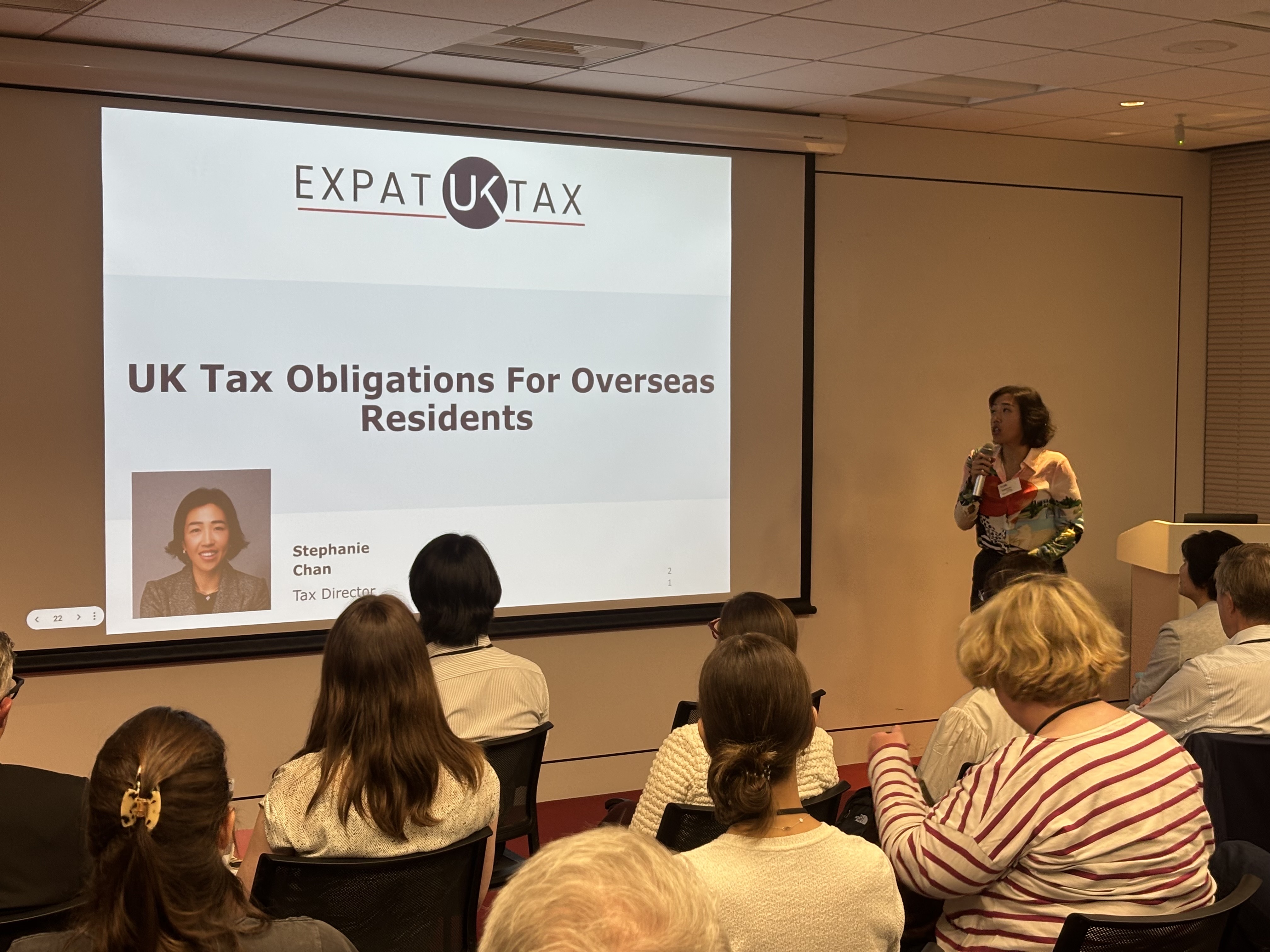
Expat UK Tax’s Chan noted that the UK government officially abandoned the concept of “domicile” as a connecting factor for tax purposes on April 6, 2025. Tax residence is now determined by the Statutory Residence Test (SRT), which is based mainly on the person’s time spent in the UK and connections to the UK, such as work, family and accommodation.
While UK residents are taxed on worldwide income, non-UK residents are taxed on UK- source income only. This applies to employment earnings, property rental, residential property gains, commercial property gains, pension income and investment income.
However, Chan pointed out that being a non-resident does not mean having no UK tax obligations. Even people who do not live in the UK may still need to file a tax return if they receive UK rental income, sell UK property, have UK income with no tax deducted, want to claim relief under a tax treaty or if HMRC requests a tax return.
Regarding filling gaps in the National Insurance record to secure a UK State Pension, as a result of the Autumn Budget 2025, non-residents will not be able to make Class 2 voluntary contributions from April 6, 2026. Furthermore, the initial residency/contributions threshold is to increase to 10 years for Class 3 voluntary contributions.
Chan also outlined HMRC’s system Making Tax Digital, which requires businesses and eligible individuals to digitally record and submit tax updates using compatible software. Quarterly reporting is mandatory for each income source, including self-employment and/or UK & overseas property. However, non-residents do not need to join the system until April 6, 2027.
Finally, UK inheritance tax is applicable to people who have been UK tax residents for at least 10 of the previous 20 tax years. The tax is applicable on the worldwide estate on death, with a rate of 40% and an allowance of £325,000.
Japanese income and inheritance tax
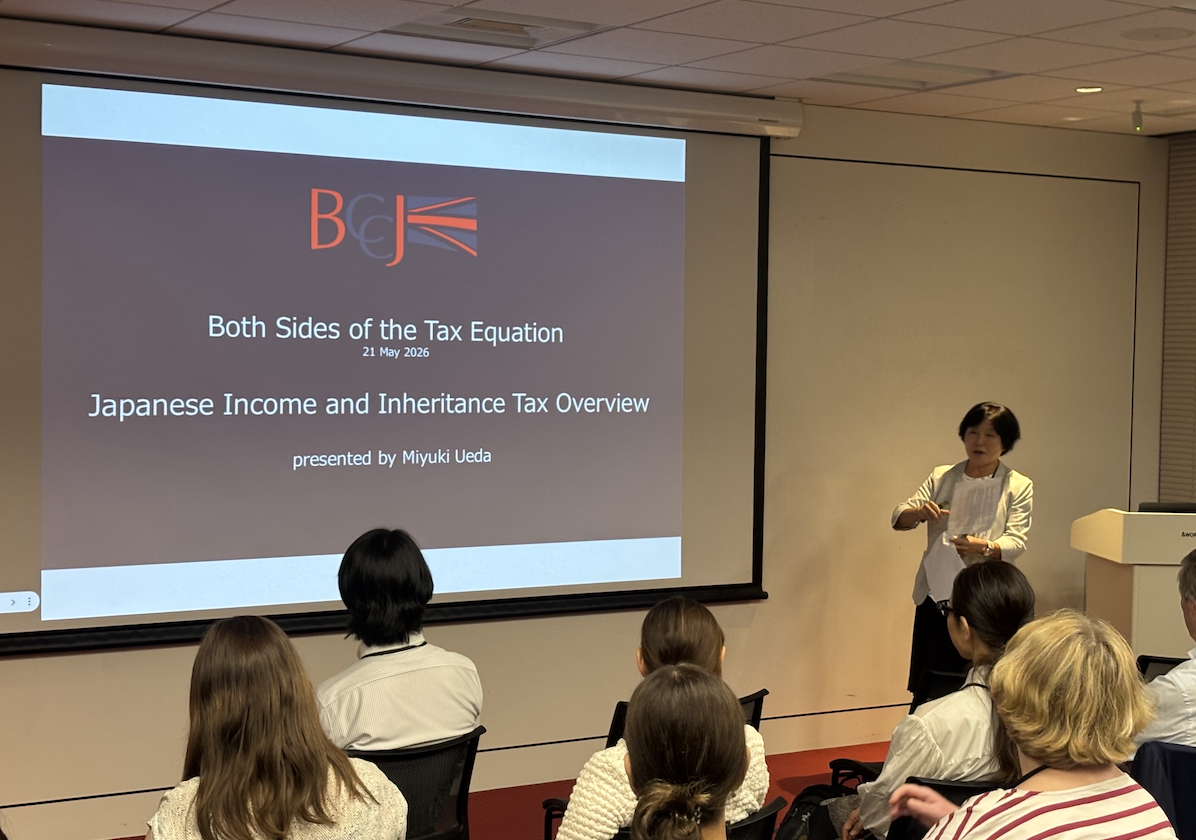
Japanese income tax rules hinge heavily on an individual’s residency status, said tax advisor Ueda. For income tax purposes, residency is defined by having a place of living in Japan for at least one year, and residents are further classified as either non-permanent or permanent residents.
Non-permanent residents are non-Japanese nationals who have lived in Japan for less than five years in total during the preceding ten years, while anyone who does not fall into this category is treated as a permanent resident. The distinction is significant, she said, because non-permanent residents are taxed only on income other than foreign-source income, except where such foreign-source income is paid in or remitted into Japan. Permanent residents, by contrast, are subject to Japanese income tax on their worldwide income.
Japan’s tax year follows the calendar year, and individuals must file an annual tax return by 15 March of the following year unless their tax liability is fully settled through withholding at source.
To address double taxation, Japan offers a foreign tax credit system, she continued. For example, a permanent resident in Japan who receives rental income from property located in the UK may credit the UK tax paid on that income against their Japanese income tax liability, subject to the usual limitations.
Inheritance tax operates under a different framework, distinguishing between limited liability taxpayers and unlimited liability taxpayers. Limited liability taxpayers are subject to Japanese inheritance tax only on assets located in Japan, whereas unlimited liability taxpayers are taxed on worldwide assets.
Determining which category applies can be complex, as it depends on a combination of factors relating to both the decedent and the heirs, including current and past residency, nationality and visa status.
For non-Japanese individuals, visa status is particularly important. Those holding a Table 2 visa—such as permanent residents and the spouses or children of Japanese nationals or permanent residents—are treated as the equivalent of Japanese nationals and are therefore more likely to fall under the unlimited liability category, exposing their worldwide assets to Japanese inheritance taxation.
For individuals planning a long-term stay in Japan, it is often advisable to consider estate planning while they remain within the limited liability taxpayer category, before their circumstances shift in a way that brings their global assets into the Japanese inheritance tax net, she concluded.


Stephanie Chan | UK Tax Director | Expat UK Tax
Contact: [email protected]

Atsunori Tsujimura | Director, Audit/Assurance and International Business Development | HLS Global
Contact: [email protected]