Event Recap: AI Safety, Security & Trust
Written by Sterling Content
AI Safety, Security & Trust
Held in partnership with Darktrace as part of its global ‘Securing AI’ campaign, the British Chamber of Commerce in Japan’s event, AI Safety, Security & Trust, brought together the British Embassy Tokyo, senior industry leaders and cross-sector experts to consider how organisations can build trusted AI at scale without compromising security.
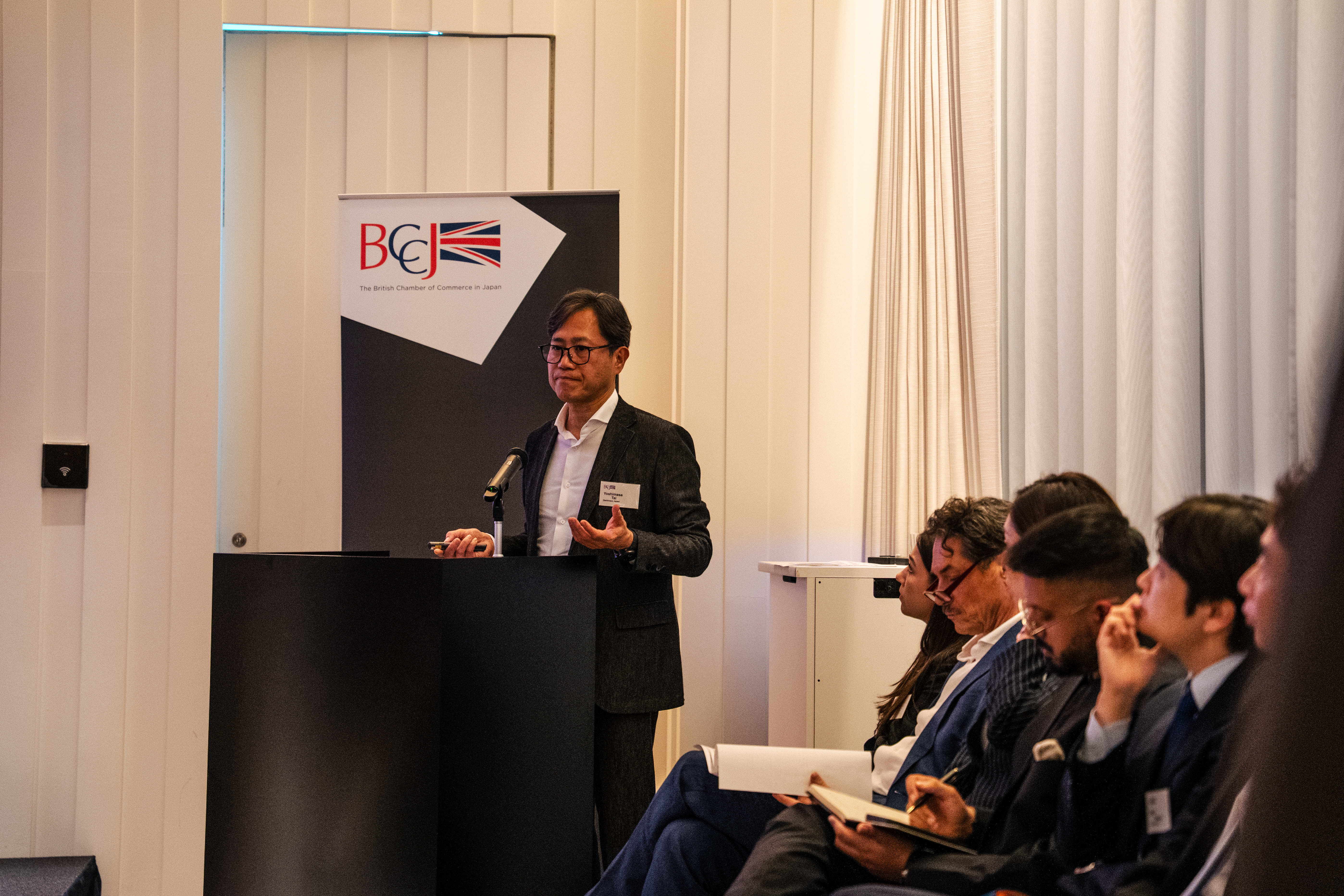
The business gathering explored how leading organisations are approaching governance, resilience and emerging risk, offering insight into the decisions shaping the next phase of AI across the UK–Japan business landscape. It comprised a keynote address, ‘Leading with Confidence in the Age of AI,’ delivered by Yoshimasa Tai, Country Manager at Darktrace Japan KK, and two panel discussions: one on governing AI and one on securing AI.
Defending security systems
Darktrace’s Tai explained that security companies traditionally rely on data from previous attacks to defend systems. However, the growing prevalence of AI means that behavioural analytics and predictive AI are now needed to spot unknown future threats.
Introducing the trends behind new types of attacks, which cyber-criminals are deploying across domains, he pointed out that 40% of attacks now exploit zero-day vulnerabilities (a security hole in a computer system unknown to its developers or anyone capable of mitigating it), according to Darktrace’s 2024 Annual Threat Report.
Attacks targeting the cloud (off-site data storage, computing infrastructure or hosted applications) are also on the rise, with new tactics aiming to steal and reset credentials.
Darktrace is also seeing threats to operational technology control systems, as well as intrusion into communication networks and critical infrastructure by state-sponsored advanced persistent threats. There is also an uptick in new methods such as email bombs and AI-generated phishing emails.
‘Attackers are exploiting the gaps between IT domains, necessitating a new, proactive or preventative approach,’ Tai said.
Darktrace therefore uses data to monitor the regular activity of organisations and find abnormalities within it, perhaps created by staff behaviours or time sequences. For example, its system can find AI agents trying to make a fake email and determine if an action is malicious based on attack speed.
Another important consideration is how to protect the AI within security systems, particularly as AI technology is developing so rapidly; 18 months ago, the number of steps towards network takeover completed by AI on a range of 0–32 (32 is full network takeover) was 0 but now it is 22, he said. Within 12 months, many AI programmes may be able to breach organisations completely, he warned.
AI governance
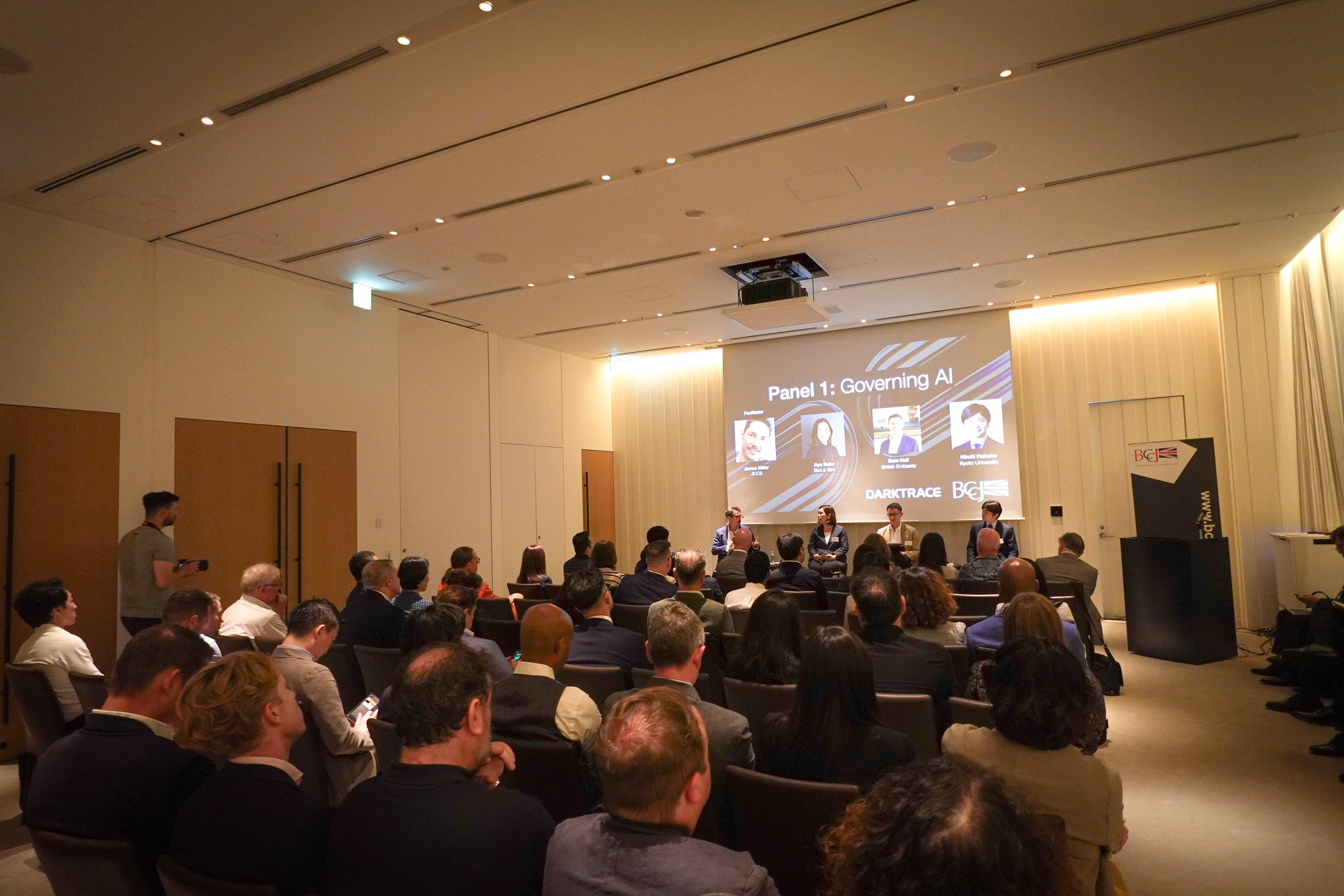
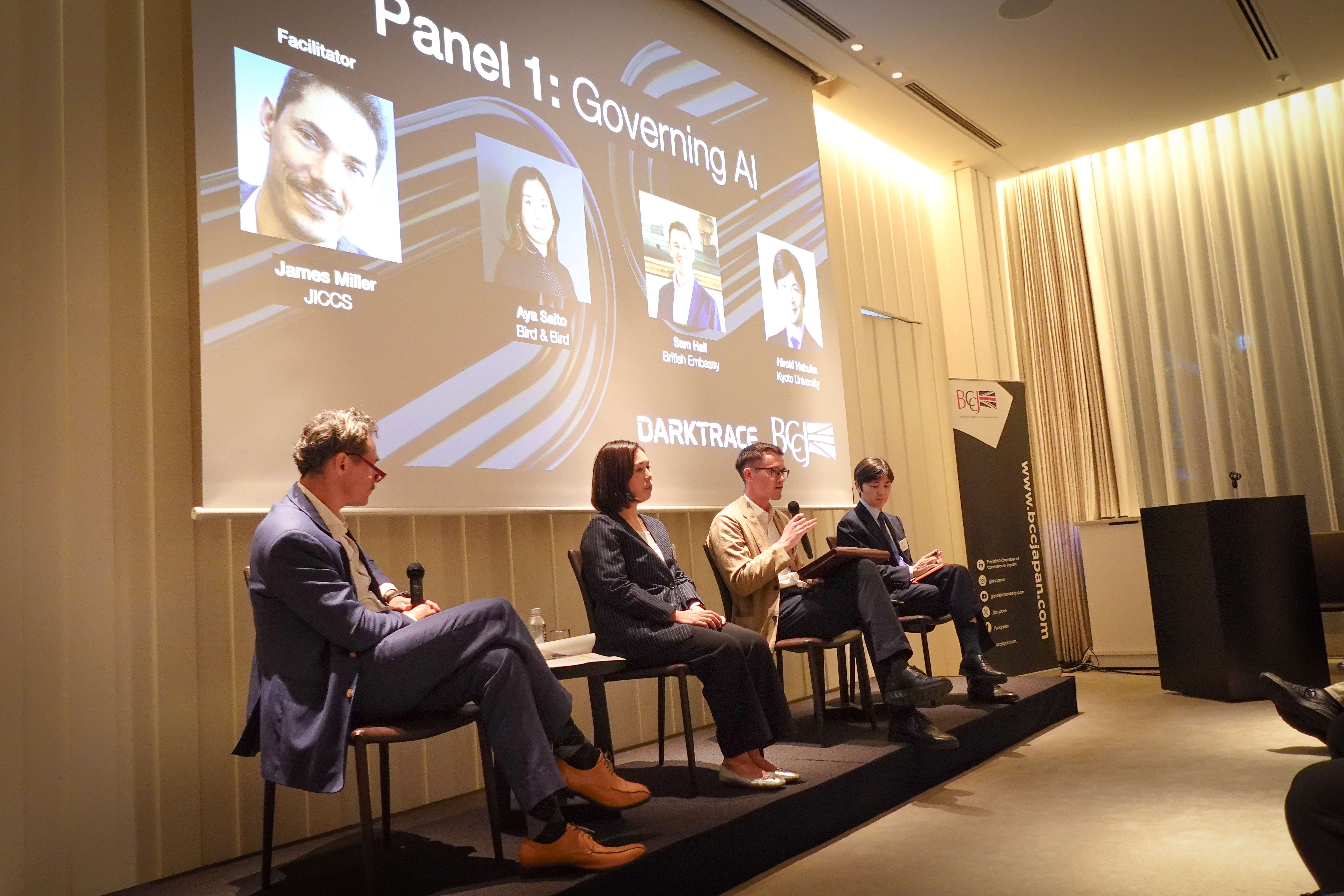
James Miller, Director of the Japan Institute for CyberSpace Studies, moderated the panel discussions. The speakers were Hiroki Habuka, CEO at Smart Governance, Ltd. and Research Professor, Graduate School of Law at Kyoto University; Sam Hall, First Secretary – Hybrid Threats & National Security at British Embassy, Tokyo; Aya Saito, Partner at Bird & Bird Gaikokuho Kyodo Jigyo Houritsu Jimusho; Akshat (Aki) Arora, Head of APAC, GTM & CX at Adobe; Hiroshi Honjo, Head of Security & Trust Office at NTT Holdings; and Yoshimasa Tai, Country Manager at Darktrace Japan KK.
With increasingly pragmatic or light-touch approaches to AI globally, governments are providing tools—rather than mandates—on how to implement AI governance, said Saito. Although intended as guidelines for organisations to create their own AI policies, those facing a shortage of resources and talent may find it tempting to simply transplant the texts into their organisation, she said.
And even with an AI policy in place, people may try to avoid any restrictions by creating exceptions, local rules and even de facto rules. In this case, ‘slowly, the gap becomes very big,’ she noted, adding that gaps can also occur if an organisation’s system ‘is not designed to work in a fluctuating and changing environment, as AI changes daily.’
Saito said traditional contracts are not crafted to consider rules and responsibilities related to AI. While there is no established approach, she noted there is ‘contractual liability’ and urged organisations to approach AI as a day-to-day commercial issue, not just in relation to regulation.
Government approaches
Habuka introduced the Japanese government’s approach to AI governance, notably its outcome-based or principle-based collaborative regulation, which is based on the UK approach. Businesses, he said, should ‘fill the gap between regulation and operation’ because the government can neither update the regulation every year nor write every detail into it.
‘Each business should be more proactive in assessing AI risks, mitigating them and being accountable to stakeholders, users or society,’ he said, adding it can be achieved via a double feedback cycle: Every day, each team would monitor AI risks at the operational level while management would consider the kind of resources that should be spent on AI governance, what kind of teams would be required for the role and so on.
Given that ‘AI has been embedded into infrastructure on which organisations, governments and economies depend,’ Hall recommended that ‘strong cyber security safeguards need to be built throughout the lifecycle of AI, from design and development to deployment and ongoing operations.’
Supply chain visibility is also essential as few organisations can build or deploy AI in isolation, he added, noting dependencies include foundation models, cloud providers, data sets, third-party vendors and software providers.
‘These often entail pretty complex international supply chains so the UK government advises businesses to understand and monitor these dependences and consider what a breakdown in the supply chain—whether as a result of geopolitical or technological reasons, export controls or natural disasters—might mean for operations.’
On bilateral agreements, Hall explained that ‘interoperability doesn’t mean identical regulation; it’s a shared understanding on how risks can be managed and evaluated … while appreciating we have different jurisdictions and needs.’ He added that the UK and Japan have taken this approach to work together, with both countries involved in global multilateral AI governance.
Building trust
NTT’s Honjo said organisations need to build trust in AI systems by embedding risk assessments, ethical governance and continuous monitoring directly into every stage of the AI lifecycle.
Furthermore, AI agents should be considered as digital coworkers that function as active team members rather than software tools, meaning that HR and business leaders need to manage their new coworkers with clear roles and guardrails.
Adobe’s Arora added that security should be factored in at the outset of considering AI, rather than after use has begun or once processes have been established.
Due to the rapidly evolving nature of the technology, Darktrace’s Tai also noted the need ‘to check in with AI every day,’ adding: ‘We have technology to protect the attack surfaces of networks and databases, but we still don’t know what comprises the AI attack surface: we have to protect that.’
In closing, Arora said, globally ‘the conversation has moved from ‘Can AI do that?’ to ‘Can we let AI do that?’’, adding it’s a ‘very big distinction in how everyone is approaching AI now.’