
AI, Responsibility & Value Creation: Innovation, Scale and the Future Beyond 2026
Past Event Round Ups
19 March 2026
The United National Conference on Trade and Development predicts the global AI market will surge in value from US$189 billion in 2023 to US$4.8 trillion by 2033, a 25-fold rise in a decade. Capital is already pouring into AI and digital transformation, with investment accelerating rapidly across industries and regions.
Yet despite this surge of interest and funding, many organisations face a critical challenge: turning experimentation into repeatable, scalable business value. A study by the Massachusetts Institute of Technology estimates that 95% of generative AI enterprise pilots deliver no return on investment.
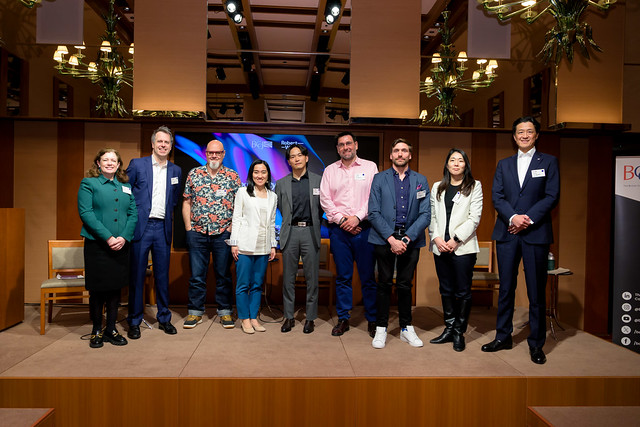
Against this backdrop, the British Chamber of Commerce in Japan assembled an expert panel of industry leaders in February to explore how businesses in Japan and overseas can close this value gap. Drawing on emerging AI strategy and practical insights from real-world experience, the discussion examined how organisations can develop approaches that convert AI potential into measurable impact.
Sponsored by Robert Walters Japan, the event comprised two panel discussions featuring the following speakers: Declan Clowry, CTO at Foundry Labs; Ben Jolley, Partner at Herbert Smith Freehills Kramer Tokyo (HSF Kramer); Takeo Kaneko, CEO and Head of Banking at HSBC Group Japan; Kayo Osaka, Global Director of Global Clients and Agency Solutions at Google Japan; Haiyang Peng, CIO at GSK Japan; Chris Sachno, Founder of EVER; Ari Sargent, CTO at Octopus Energy; and Mari Sekino, CEO, QERA. Moderation was provided by cyber advisory founder & consultant Nicola Vote.
Embracing experimentation
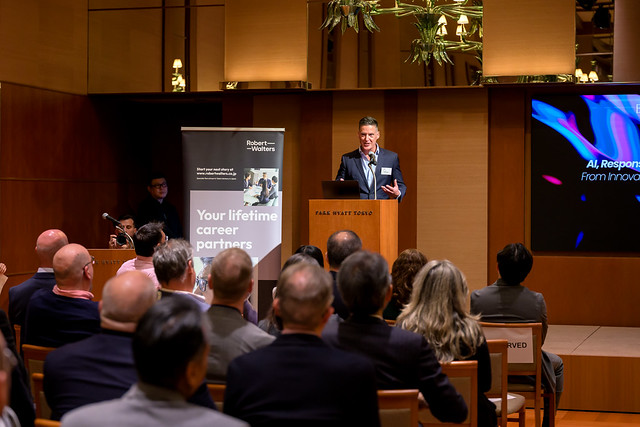
Commenting on the use of AI in Japan, Google’s Osaka said Japan’s 'high context culture' makes it difficult to measure everything in data terms, yet data is vital in order to scale. She suggested corporate leaders experiment with the technology to get 'hands on' familiarity with AI.
'Try remembering the first smartphone that you had … there was no manual, you started just playing with it, clicking and scrolling, and that’s how we got used to it. My suggestion with AI is to do the same,' she said. 'Leaders must be primary users, and it’s the new operating system, so we need to play with it, we need to learn from it, and we need to be leading the way and encourage everybody else to use it.'
Osaka added that it is crucial to have clear goals on measurement and return on investment (ROI), but ultimately, 'data is the only language AI speaks.'
Managing risk
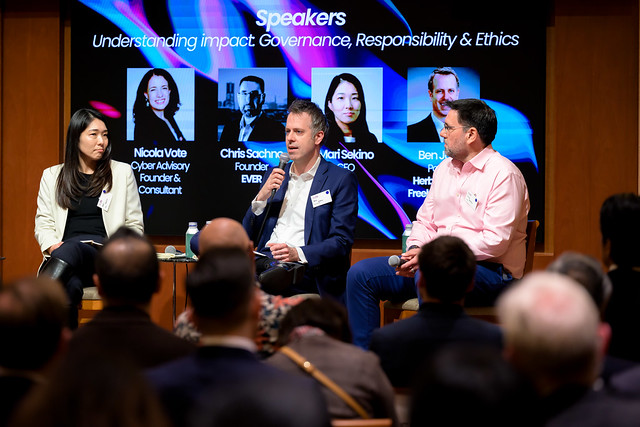
GSK Japan’s Peng pointed to the need for 'strong governance, responsible AI development frameworks and clear accountability' to unlock value from AI.
HSF Kramer’s Jolley suggested it was essential to 'balance the protection of harm and risk that comes from AI with the ability to have progress and innovation.'
'I think one of the difficulties for regulators and for governments, is around catching up with AI technology. It moves too quickly to regulate effectively,' he said. 'To show how quickly technology is moving, World Economic Forum research suggests that less than 1% of organisations around the world have adopted fully operational, responsible AI governance … so there is a lot of work to be done to catch up.'
EVER’s Sachno said AI needs to be 'trusted and safe' for people to feel comfortable using it: 'In most Western democracies, trust [in AI] is around 30–40% … maybe too many people have watched the ‘Terminator’ or ‘Matrix’ movies,' he said.
Commenting on the ethics of AI, QERA’s Sekino said 'the most fundamental issue is how to embed it every technology or service,' while keeping in mind the need to protect human rights.
Boosting productivity
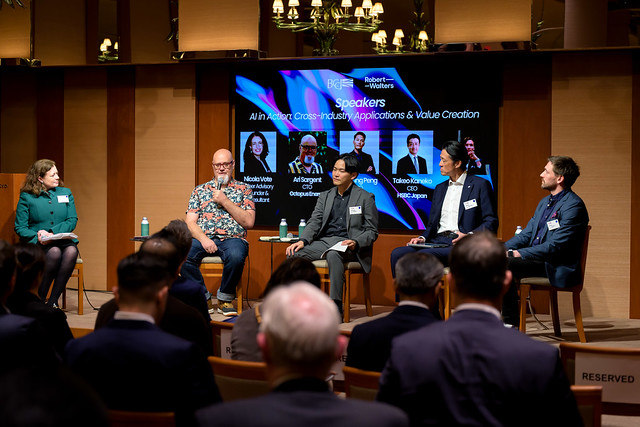
Foundry Labs’ Clowry said the productivity benefits of AI have been understated, pointing out 'there are lots of very well proven massive increases in productivity and quality from AI – for example Domino’s Pizza in the US, where 80% of orders are now done using voice AI.'
Another example is a French survey of 200 businesses that found the average ROI from adopting various kinds of standard Generative AI technology was about 150%, he said, adding that 'people are getting massively impactful results.'
Clowry also noted the 'transformative' benefits of AI technology in translation services, pointing out it is now possible to have simultaneous online translation in meetings involving Chinese, English, Japanese and other staffers.
HSBC’s Kaneko said his bank has been working with AI for many years with the earliest machine learning models, developed over a decade ago. AI, he explained, is used in myriad ways at HSBC, including 'fraud detection and transaction monitoring, customer service and risk management.'
GSK’s Peng cited the example of a US healthcare company that developed an AI model predicting 'no shows' at appointments, which achieved a 34% reduction in cancellations, a significant benefit to the healthcare provider.
Octopus Energy’s Sargent said AI is empowering the 'critical un-locker to a smart grid involving more consumer participation,' adding that AI can 'build confidence that you can make smart decisions about distributed energy,' including consumption, generation and storage.